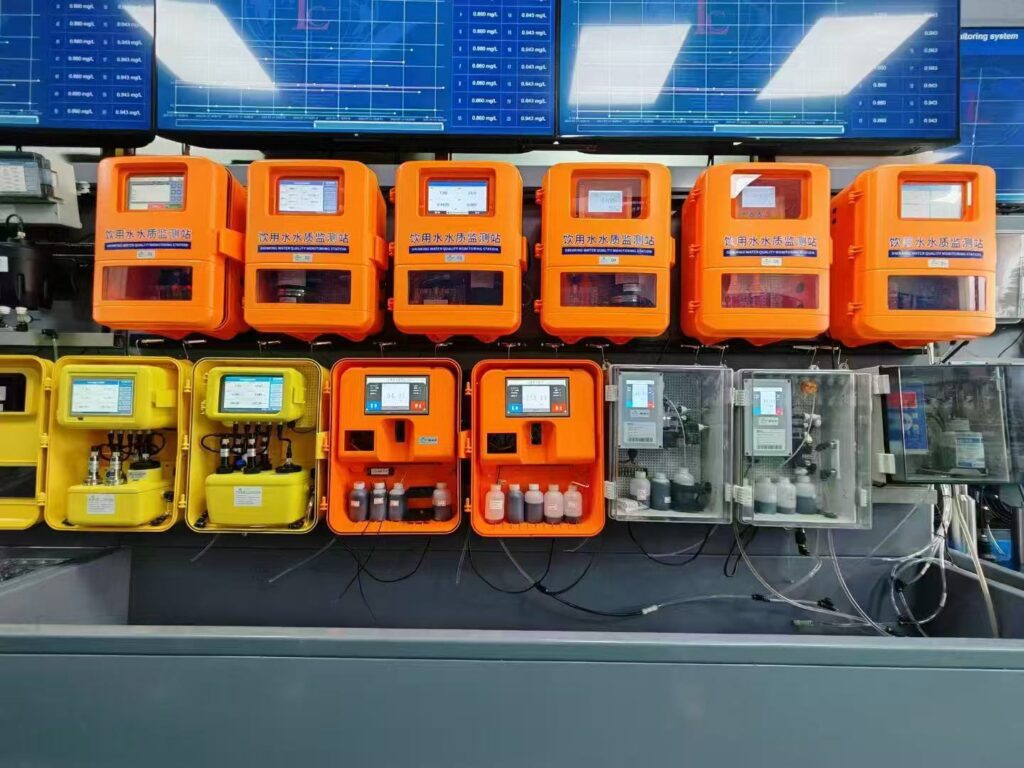
Free alkali content is a critical control indicator in industrial water treatment, chemical production, textile printing and dyeing, and boiler circulating water systems. Excessive or fluctuating free alkali concentration will easily cause equipment scaling, pipeline corrosion, reduced reaction efficiency and unqualified discharge water quality. Traditional manual titration methods suffer from cumbersome operation, serious human errors and severe data lag, which cannot meet the demands of continuous, real-time and high-precision monitoring in modern industrial production. The high-precision online free alkali analysis and testing system solves the above pain points effectively. It enables automatic, uninterrupted and accurate detection of free alkali content in water bodies and industrial solutions, providing reliable data support for production process optimization, equipment protection and environmental compliance supervision. This article elaborates on its working principle, core technical features, typical functions and operating condition adaptation rules in detail.
1. Working Principle of Online Free Alkali Analysis System
The high-precision online free alkali analysis system mainly adopts the standardized automatic acid-base titration principle combined with photometric endpoint detection and intelligent algorithm compensation, which is consistent with national and industrial standard detection methods. The system realizes automatic sampling, constant-temperature reaction, quantitative reagent dosing, real-time signal acquisition and data calculation through integrated mechanical and electronic control modules.
During operation, the precise sampling pump extracts a fixed volume of water sample, and the filtered and pretreated sample enters the titration reaction cell. The system automatically adds standard acid titrant to carry out neutralization reaction with free alkali components in the sample. It identifies the titration endpoint accurately via photometric sensing and high-sensitivity signal perception, and calculates the real-time free alkali concentration based on the consumed titrant volume, combined with built-in temperature compensation and concentration correction algorithms. Compared with manual detection, the whole process avoids human operation errors and realizes standardized and intelligent full-process detection.
2. Core Technical and Functional Features
Different from conventional water quality analyzers, the free alkali online monitoring system is specially optimized for alkaline solution detection scenarios, with prominent advantages in detection accuracy, operational stability and intelligent level, adapting to the rigorous control requirements of industrial fine production.
2.1 High-Precision Detection Performance
The system is equipped with high-precision quantitative dosing modules and high-resolution signal sensors, achieving ultra-low detection limits and full-scale high linearity. It supports trace and conventional free alkali concentration detection, with extremely low measurement repeatability error and long-term drift. Built-in PT1000 high-precision temperature sensors realize real-time temperature compensation, effectively eliminating the detection deviation caused by ambient temperature and sample temperature changes, and ensuring stable and accurate detection data in complex industrial environments.
2.2 Full Automatic Intelligent Operation
It supports 24-hour unattended automatic operation, covering automatic sampling, sample pretreatment, quantitative reagent feeding, constant-temperature titration, endpoint judgment, data calculation and result uploading. The system comes with a programmable detection cycle, which can flexibly set monitoring frequency according to production demands. In addition, it has built-in data storage, historical query, trend analysis and audit tracking functions, which can record long-term monitoring data completely, facilitating production parameter traceability and quality management.
2.3 Efficient Anti-Interference and Anti-Pollution Capability
Aiming at the characteristics of industrial water samples such as high turbidity, many impurities and complex components, the system is equipped with a professional sample pretreatment unit including filtering and impurity removal modules. It can effectively block suspended solids, sediments and particulate impurities in the water sample to avoid pipeline blockage and sensor contamination. Meanwhile, the core detection components adopt anti-corrosion and high-sealing design, which resists the corrosion of alkaline solutions and ensures long-term stable operation of the equipment.
2.4 Diversified Alarm and Linkage Functions
Users can set upper and lower limit thresholds of free alkali concentration according to production process standards and environmental protection requirements. When the detection value exceeds the preset range, the system will automatically trigger sound and light alarms, and support remote data transmission and signal linkage. It can be docked with factory DCS and PLC control systems to realize automatic adjustment of dosing and water treatment processes, forming closed-loop monitoring and control.
3. Operating Condition Adaptation Specifications
The stable operation and accurate detection of the free alkali analysis system depend on standardized operating environment and sample condition adaptation. Clear application condition boundaries can effectively avoid equipment failure and data distortion, and extend the service life of the instrument.
3.1 Ambient Environmental Conditions
The applicable ambient temperature of the equipment ranges from 5°C to 40°C, and the operating environment humidity is controlled at 20%–90% RH without condensation. It should be installed in a dry, dust-free and well-ventilated place, avoiding direct sunlight, strong electromagnetic interference and severe vibration. For outdoor or high-humidity workshop environments, it is necessary to equip protective shells and waterproof and dustproof accessories to ensure the stable operation of internal circuits and optical components.
3.2 Water Sample Parameter Adaptation
The system is suitable for water sample temperature of 5°C to 60°C and normal-pressure water sample sampling. For pipeline pressure sampling scenarios, a matched pressure regulator needs to be configured to stabilize the sampling pressure and prevent excessive pressure from damaging the sampling pump and reaction cell. The built-in pretreatment filter can intercept conventional suspended impurities; for water samples with high viscosity and excessive oil stains, a customized enhanced pretreatment device is required to ensure the purity of the test sample.
3.3 Industrial Scenario Adaptation
This free alkali online monitoring system is widely applicable to multiple industrial scenarios. In the field of boiler circulating water and power plant water treatment, it monitors free alkali concentration in real time to prevent pipeline scaling and corrosion and ensure the safe operation of thermal equipment. In textile printing and dyeing and chemical production processes, it tracks alkali liquor concentration changes to stabilize production process parameters and improve product qualification rate. In industrial sewage discharge and water environmental monitoring, it provides accurate free alkali data to ensure that discharge indicators meet environmental protection standards.
4. Daily Operation and Maintenance Key Points
Standardized daily maintenance is the core to maintain the high precision and long-term stability of the free alkali analysis system. Scientific operation and maintenance can effectively reduce equipment failure rate, avoid data drift, and reduce operation and maintenance costs.
Regular cleaning and dredging: Clean the sampling pipeline, filter element and titration reaction cell regularly every week to remove residual alkali liquor, sediments and reaction residues, prevent pipeline blockage and component contamination, and avoid affecting the titration endpoint judgment.
Periodic calibration verification: Conduct zero calibration and standard solution calibration every 7–15 days to eliminate instrument drift caused by long-term operation. Conduct full-scale accuracy verification quarterly to ensure that the detection error is within the standard range.
Timely replacement of consumables: Regularly replace titration reagents
filter elements and aging sealing parts according to the operating frequency. Prevent detection failure and data distortion caused by reagent failure and filter blockage.
Daily status inspection: Check the power supply stability, pipeline tightness and data transmission status every day. Observe the alarm record and data trend, and troubleshoot abnormal fluctuations in time to ensure continuous and reliable system operation.
5. Conclusion
The high-precision online free alkali analysis and testing system has become an indispensable intelligent monitoring device in modern industrial water treatment and chemical production. With its automatic detection capability, high-precision measurement performance and strong working condition adaptability, it makes up for the shortcomings of traditional manual detection methods. Standard application scenarios and standardized daily maintenance can give full play to the system’s monitoring advantages, effectively help enterprises stabilize production processes, reduce equipment operation risks, and meet strict environmental protection and production quality control requirements.
Scan the QR code to receive more detailed information.