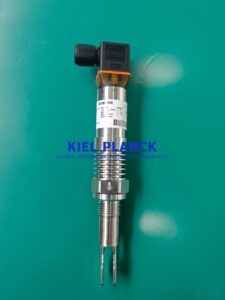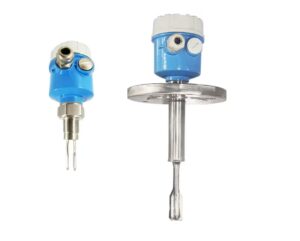
The core working mechanism depends on piezoelectric excitation and vibration signal monitoring. Built-in piezoelectric ceramics drive the metal tuning fork to vibrate at a fixed natural resonant frequency in the air. When the fork contacts liquid or solid media, external damping force changes its vibration frequency and amplitude. The internal intelligent circuit captures this subtle signal variation and converts it into standard switching signals for industrial control systems. Featuring simple structure, anti-interference capability, maintenance-free operation and wide adaptability, tuning fork level switches have become mainstream equipment for high-precision level monitoring in chemical, pharmaceutical, food and petrochemical industries. This paper elaborates on its non-mechanical operating principle, core component functions, technical advantages and practical application values.
1. Introduction
Level detection is a fundamental link in industrial fluid and material processing, which guarantees production safety, avoids material overflow or equipment empty running, and realizes automated process control. Traditional mechanical level switches generally adopt movable mechanical structures, which are prone to wear, jamming and failure after long-term operation, especially in working conditions with high viscosity, impurity and corrosive media, resulting in high maintenance costs and unstable detection results. In contrast, the tuning fork level switch abandons all movable mechanical components. Its integrated probe design enables non-contact and non-mechanical induction level detection, effectively overcoming the defects of traditional mechanical sensors. With outstanding reliability and environmental adaptability, it has gradually replaced traditional level detection equipment in most industrial scenarios.
2. Core Working Principle Without Moving Parts
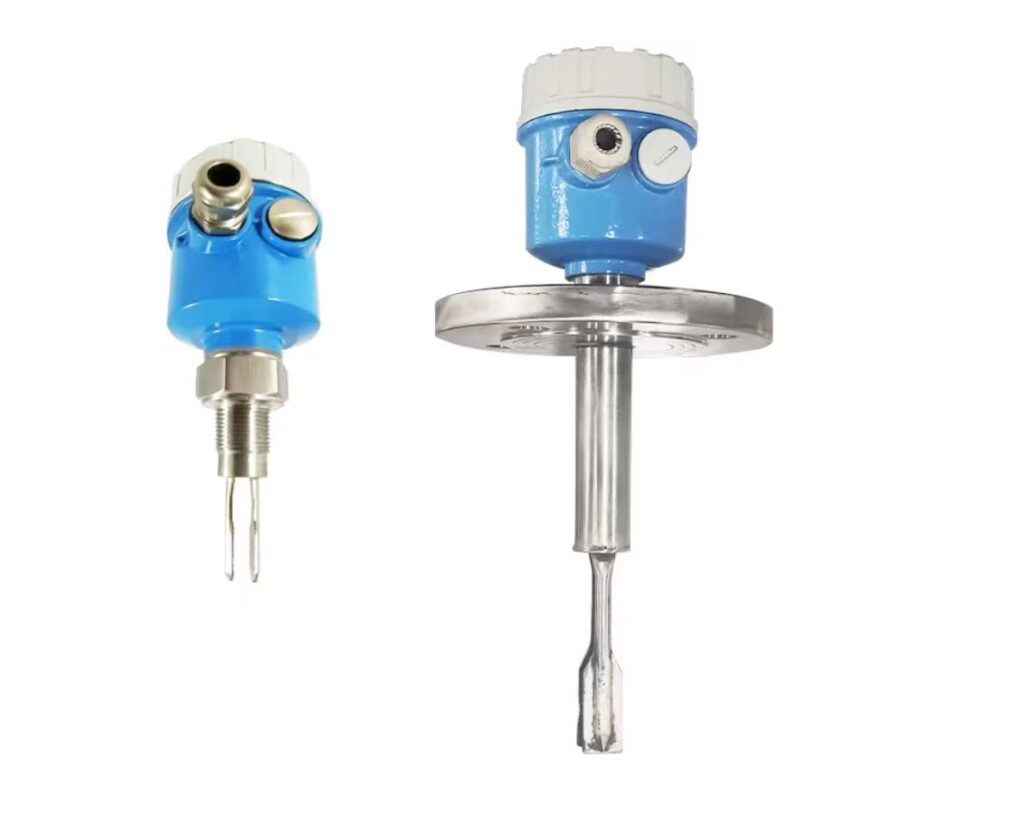
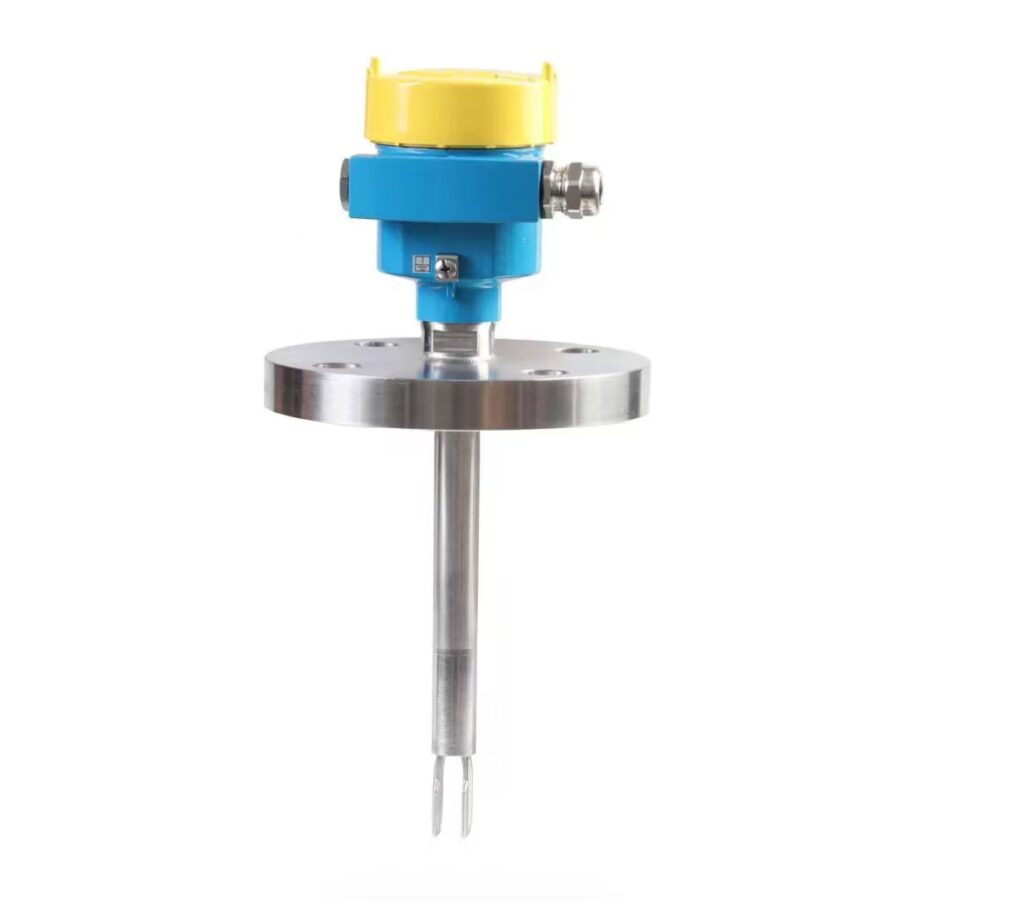
The entire detection process of the tuning fork level switch relies on piezoelectric effect and vibration resonance damping principle, with no mechanical rotation, flipping or floating movement throughout the process. Its internal core structure consists of two sets of independent piezoelectric ceramic components and a metal tuning fork probe, forming a closed-loop vibration detection system.
The first set of piezoelectric elements serves as the driving unit. After being powered on, the alternating voltage acts on the piezoelectric ceramics, which convert electrical energy into mechanical vibration energy based on the inverse piezoelectric effect. This drives the external double-pronged metal tuning fork to generate continuous and stable vibration at its inherent resonant frequency. In the air environment without medium contact, the tuning fork is in a free resonance state with fixed vibration frequency and stable amplitude, and the system maintains a normal operating state without outputting alarm or switching signals.
The second set of piezoelectric elements acts as the signal receiving and monitoring unit, responsible for real-time acquisition of tuning fork vibration parameters. When the liquid or bulk solid material rises to cover the tuning fork probe, the medium forms a damping effect on the vibrating fork body. This external resistance will instantly change the tuning fork’s resonant state, reduce its vibration amplitude and shift its natural frequency. The built-in high-sensitivity circuit can accurately capture this tiny vibration change that cannot be identified by the human eye.
After analyzing and judging the vibration parameter changes, the control circuit converts the physical vibration variation into standard electrical switching signals, realizing functions such as high-level alarm, low-level protection and pump start-stop control. When the material level drops and the tuning fork is exposed to the air again, the damping force disappears, the fork quickly returns to the original resonant frequency and amplitude, and the switch automatically resets to the initial state. The whole process only involves vibration changes without any mechanical wear or displacement.
3. Unique Technical Advantages
The non-moving part design endows tuning fork level switches with unparalleled technical advantages in industrial applications. Firstly, the fully fixed structural design eliminates mechanical wear, jamming and fatigue failure, greatly extending the service life of the equipment and realizing long-term maintenance-free operation. Secondly, the vibration induction principle is not affected by medium viscosity, density, foam and fluid fluctuation, with strong anti-interference ability and stable detection accuracy.
In addition, the equipment requires no manual calibration after installation, with simple debugging and low operation threshold. It can adapt to various harsh working conditions including high temperature, high pressure, corrosion and dust. Compared with radar level meters and ultrasonic level meters, it has lower cost and higher cost performance in point-level detection scenarios, making it suitable for popularization and application in various industrial production lines.
4. Industrial Application Scenarios
Tuning fork level switches are widely used for point-level monitoring of liquids, powders and granular materials. In the chemical industry, they are used for level limit protection of corrosive solvents and chemical raw material storage tanks. In the food and pharmaceutical industry, their sanitary and wear-free structure meets the hygienic production standards, suitable for detecting beverage, syrup and medicinal liquid levels. In petrochemical and energy industries, they monitor the level of oil products and coal ash materials to prevent equipment overload and empty running failures. Moreover, they can also be applied in water treatment, building materials and metallurgy industries, covering most conventional industrial level detection scenarios.
5. Conclusion
In essence, the tuning fork level switch realizes accurate level detection through piezoelectric vibration excitation and resonant damping induction, completely getting rid of the dependence on moving mechanical parts. Its core logic is to take the physical vibration state of the tuning fork as the detection benchmark, judge the medium contact state through real-time monitoring of vibration frequency and amplitude changes, and output control signals. The non-moving structure fundamentally solves the failure problems of traditional mechanical level sensors caused by mechanical wear and jamming. With high stability, low maintenance cost and strong environmental adaptability, tuning fork level switches provide a reliable and efficient solution for industrial point-level detection, and will continue to play an important role in the field of industrial automation control in the future.
Scan the QR code to receive more detailed information.