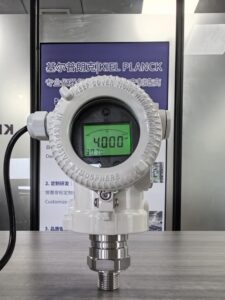
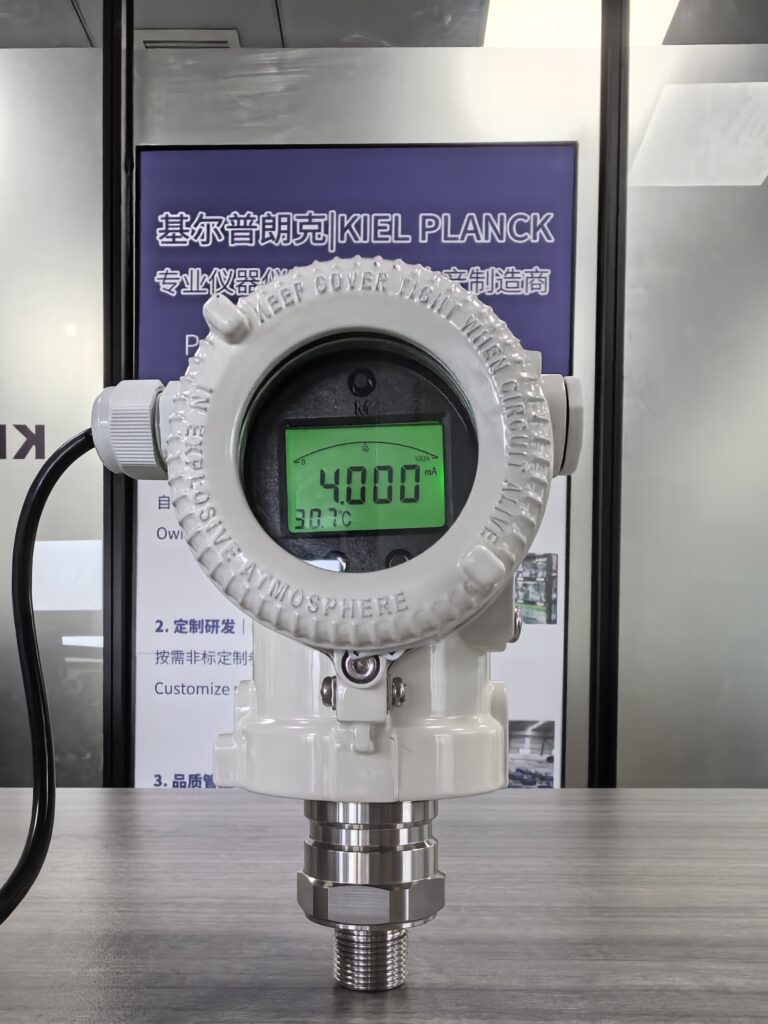
When selecting a high-accuracy silicon pressure transmitter, many buyers face the same question: Should they choose 0.05% or 0.1% accuracy?
A higher accuracy specification may improve measurement performance, but it can also increase the purchase cost. The best choice depends on the process requirements, measuring range, operating conditions, and total cost of ownership.
This guide explains the key differences and helps you avoid paying for accuracy that your application does not need.
1. What Do 0.05% and 0.1% Accuracy Mean?
Accuracy specifications are commonly expressed as a percentage of full scale, although the exact definition depends on the manufacturer’s datasheet.
If the specification is based on full scale, the corresponding error limits are:
| Measuring Range | 0.05% of Full Scale | 0.1% of Full Scale |
|---|---|---|
| 10 bar | ±0.005 bar | ±0.01 bar |
| 40 bar | ±0.02 bar | ±0.04 bar |
| 100 bar | ±0.05 bar | ±0.1 bar |
These values illustrate the difference between the two specifications. They do not represent the complete measurement uncertainty under every operating condition.
Always confirm whether the stated accuracy includes nonlinearity, hysteresis, repeatability, temperature effects, and other relevant factors.
2. When Should You Choose 0.05% Accuracy?
A 0.05% accuracy transmitter may be appropriate when the application has demanding measurement requirements.
Typical examples include:
Precision pressure monitoring in industrial test equipment
Applications requiring tighter process control
Reference measurements where the instrument specification supports the required uncertainty
Systems where measurement errors could cause significant production losses
However, a more accurate transmitter cannot compensate for an unsuitable measuring range, poor installation, incorrect calibration, or excessive temperature effects.
Confirm that the complete measurement system meets the required performance.
3. When Is 0.1% Accuracy Enough?
For many conventional industrial applications, a 0.1% accuracy transmitter may provide sufficient performance.
Potential applications include:
General industrial equipment
Water treatment systems
Pressure monitoring in production lines
Hydraulic and pneumatic equipment
Routine process monitoring
The correct choice depends on the process tolerance and the accuracy required by the control system.
If the application does not require the tighter specification of a 0.05% instrument, purchasing the higher-grade model may offer limited practical benefit.
4. Consider More Than Accuracy
Before choosing a pressure transmitter, evaluate these factors:
Measuring range: Select a range that covers normal operating pressure and expected pressure peaks.
Long-term stability: Check drift over time and the manufacturer’s calibration recommendations.
Temperature effects: Review the specified operating temperature and temperature-related measurement errors.
Response time: Confirm that the instrument responds quickly enough for the process.
Medium compatibility: Verify the wetted materials and seals.
Total cost: Consider the purchase price, installation, calibration, maintenance, and potential downtime.
These factors can be as important as the nominal accuracy grade.
5. How to Make a Cost-Effective Choice
Use the following process before placing an order:
Define the required measurement tolerance.
Confirm the normal pressure and maximum pressure.
Compare the accuracy specifications under equivalent conditions.
Review temperature effects and long-term stability.
Check whether the selected model meets the process requirements.
Compare the total cost rather than the purchase price alone.
Ask suppliers to provide the relevant technical datasheet and calibration information so that different models can be evaluated fairly.
Frequently Asked Questions
Q1: Is 0.05% always better than 0.1%?
It provides a tighter stated accuracy limit when the specifications are defined on the same basis. Whether this difference is necessary depends on the application.
Q2: Does accuracy equal total measurement uncertainty?
No. Total uncertainty may also include calibration uncertainty, temperature effects, installation influences, and other sources of error.
Q3: Which accuracy grade should I choose?
Choose the grade that meets your required measurement tolerance with an appropriate margin. Avoid paying for specifications that do not improve the actual process.
Conclusion
Both 0.05% and 0.1% accuracy silicon pressure transmitters can be suitable for industrial applications. The right choice depends on measurement requirements, operating conditions, stability, and budget.
A clear understanding of these factors helps you select a cost-effective pressure transmitter without sacrificing necessary measurement performance.
Need help selecting a pressure transmitter? Contact our team with your measuring range, medium, operating temperature, and accuracy requirements for a suitable recommendation.
Scan the QR code to receive more detailed information.