Why Pressure Monitoring Is Critical in Hydrogen Refueling
A hydrogen refueling station receives, stores, compresses, and dispenses hydrogen.
Depending on the station design, the system may include:
Hydrogen supply equipment.
Compressor package.
High-pressure storage banks.
Pressure control equipment.
Priority panels.
Dispenser.
Cooling equipment.
Vent and safety systems.
Control cabinets and instrumentation.
Pressure measurements are required at several points to monitor equipment operation and support the control strategy.
The actual pressure levels and measurement locations depend on the station design, applicable refueling protocol, equipment ratings, and project specifications.
Pressure monitoring is not a substitute for mechanical pressure protection. Pressure relief devices and other protection measures must be designed separately.
1. Pressure Monitoring in High-Pressure Storage Banks
Hydrogen storage banks contain pressurized gas and are commonly divided into groups or banks according to the station design.
Pressure measurement may be required at:
Individual storage banks.
Bank outlet manifolds.
Common supply headers.
Compressor discharge.
Pressure control equipment.
The measurement signals may be used for indication, control, pressure management, and alarm functions.
Before selecting the transmitter, confirm:
Normal operating pressure.
Maximum operating pressure.
Design pressure.
Possible pressure transients.
Required accuracy.
Process connection.
Hydrogen compatibility.
Hazardous-area classification.
High-pressure applications require particular attention to the pressure rating of the complete transmitter assembly.
2. Pressure Measurement at the Compressor Outlet
The compressor discharge is another important pressure measurement point.
The pressure transmitter can provide information about the compressor’s discharge condition and support the control system.
However, compressor discharge pressure may fluctuate during loading, unloading, and other operating transitions.
The transmitter should therefore be selected according to the expected operating range and transient conditions.
If pressure pulsation is significant, the engineering team should evaluate the installation and signal response.
Excessive damping should not be used to conceal genuine pressure changes or delay required protection functions.
3. Pressure Monitoring in the Dispenser System
Hydrogen dispensers use pressure measurement as part of the refueling control and monitoring arrangement.
The exact sensor locations and functions depend on the dispenser design and applicable standards.
Pressure monitoring may be used to observe supply conditions and support the control system.
Because dispensing can involve rapid changes in pressure, the response characteristics and pressure rating of the selected instrument must be reviewed.
The instrument should be suitable for the actual gas service, operating temperature, pressure range, and required measurement function.
The dispenser manufacturer’s approved design should determine the final sensor configuration.
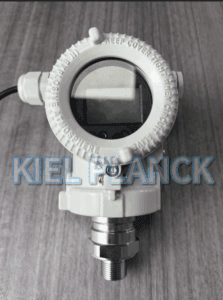
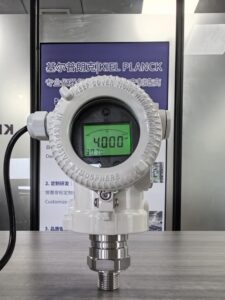
4. Five Key Factors for Selecting High-Pressure Hydrogen Transmitters
Pressure Range and Pressure Rating
Confirm the normal operating pressure, maximum operating pressure, design pressure, and possible transient conditions.
The calibrated range and allowable overload must be evaluated separately.
The process connection and all pressure-containing components must be suitable for the application.
Hydrogen Compatibility
Hydrogen permeation and material compatibility must be considered for the complete wetted assembly.
Review diaphragm material, process connection, sealing materials, and manufacturer recommendations.
Do not assume that a stainless-steel housing alone proves hydrogen compatibility.
Accuracy and Stability
The required accuracy depends on the measurement function.
For monitoring and control applications, compare the accuracy specification and reference basis.
Long-term stability may also be important where continuous operation and long maintenance intervals are expected.
Temperature and Environmental Conditions
Check process temperature, ambient temperature, vibration, moisture, and installation environment.
The selected transmitter must operate within its specified limits.
Hazardous-Area Certification
Confirm the required hazardous-area zone or division, gas group, temperature class, and protection concept.
The certification must match the actual model and configuration.
Cable glands, wiring accessories, barriers, and installation methods should also be reviewed.
5. Pressure Monitoring in Control Cabinets and Instrument Panels
Pressure transmitters may send signals to a local control cabinet or a central control system.
The cabinet itself is not necessarily located in the same hazardous area as the pressure connection.
The installation location of each component must be evaluated separately.
Where the transmitter is installed in a hazardous area, its certification and wiring arrangement must match the area classification.
The control cabinet should be designed according to the project electrical and environmental requirements.
6. Common Selection Mistakes
Selecting a transmitter based only on the nominal pressure.
Ignoring transient pressure during refueling.
Assuming all hydrogen-compatible materials are interchangeable.
Choosing hazardous-area certification without checking the actual gas group.
Ignoring pressure connection ratings.
Using a standard transmitter in a location requiring a specific certified configuration.
Treating a measurement transmitter as a pressure protection device.
7. Documentation Buyers Should Request
Before procurement, request:
Product datasheet.
Pressure range and overload specifications.
Wetted material details.
Hydrogen-service compatibility confirmation.
Hazardous-area certificates.
Output and wiring information.
Temperature ratings.
Process connection details.
Installation instructions.
Calibration documentation, where required.
Conclusion
Hydrogen refueling stations require pressure monitoring at storage banks, compressor outlets, manifolds, and dispensing equipment according to the actual system design.
Selecting a suitable pressure transmitter requires reviewing high-pressure capability, hydrogen compatibility, accuracy, temperature, output, and hazardous-area certification.
For hydrogen station equipment manufacturers and system integrators, the correct approach is to define every measurement point from the approved P&ID and equipment documentation before selecting the transmitter.
Scan the QR code to receive more detailed information.