It further analyzes key interference factors including water temperature and ionic strength, and proposes targeted correction and error control measures. By comparing the applicable scenarios and limitations of different calculation approaches, this study aims to provide standardized and scientific calculation guidelines for environmental workers and laboratory researchers, ensuring the authenticity and accuracy of water pH monitoring data.
1. Introduction
pH detection and calculation are indispensable in natural water environment supervision, industrial wastewater treatment, aquaculture and daily water quality testing. Unlike intuitive water quality indicators such as turbidity, pH value cannot be directly observed but must be calculated and corrected based on ion activity and environmental conditions. Ideal laboratory solutions feature stable components and few interferences, while actual water bodies contain suspended solids, diverse electrolyte ions and variable temperatures, which easily cause deviations in traditional theoretical calculation results. Therefore, adopting scientific, scenario-based pH calculation methods and eliminating external interferences are essential to obtain reliable water quality data and support precise water quality evaluation and treatment decisions.
2. Basic Theoretical Principle of pH Calculation
The pH value is scientifically defined as the negative base-10 logarithm of the hydrogen ion activity in an aqueous solution, with the core calculation formula expressed as pH = -lg[H⁺], where [H⁺] refers to the molar concentration of active hydrogen ions (mol/L). Correspondingly, the hydroxide ion concentration is calculated as pOH = -lg[OH⁻]. At the standard temperature of 25°C, the ion product constant of pure water (Kw) is fixed at 1×10⁻¹⁴, forming the balanced relationship pH + pOH = 14. Under this standard condition, a pH of 7 indicates neutral water, a pH below 7 indicates acidity, and a pH above 7 indicates alkalinity.
Notably, the simple concentration-based formula only applies to ideal dilute solutions. In high-salinity water, industrial wastewater and other complex water bodies, ion interactions reduce hydrogen ion activity. In such cases, ion activity rather than molar concentration must be adopted for calculation to reduce theoretical errors and improve result accuracy.
3. Two Mainstream pH Calculation Methods
3.1 Theoretical Formula Calculation
This method is primarily applicable to pure water, distilled water and low-impurity surface water with stable and simple components. After measuring the accurate hydrogen ion concentration of a water sample through laboratory chemical analysis, workers can directly calculate the pH value via the logarithmic formula. For instance, a neutral dilute solution with a hydrogen ion concentration of 1×10⁻⁷ mol/L has a standard pH value of 7. This calculation method boasts simplicity, high efficiency and negligible errors, making it the preferred approach for conventional laboratory water sample detection and theoretical analysis.
3.2 Instrument Conversion Calculation
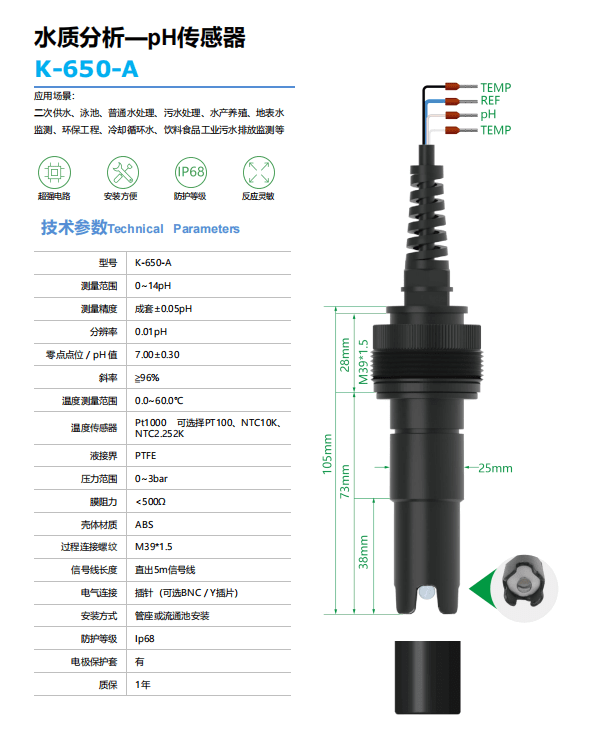
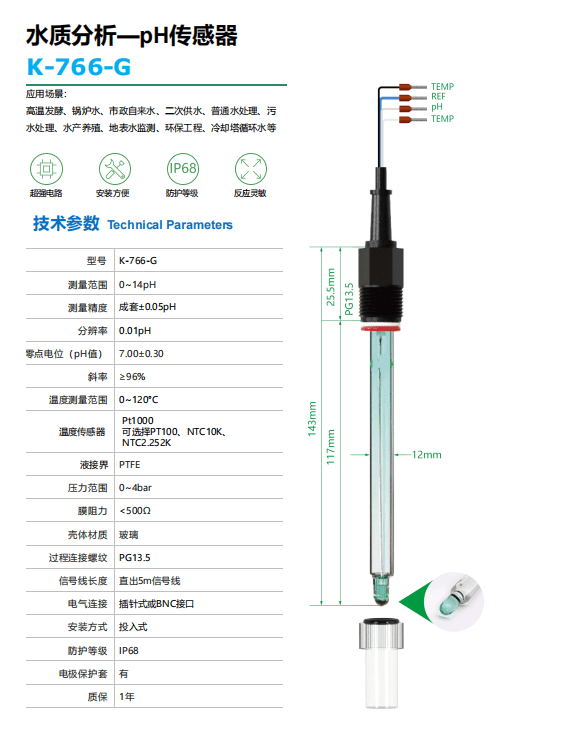
Complex water bodies such as river water, aquaculture water and industrial wastewater contain abundant organic matter, suspended sediments and electrolyte ions, which invalidate simple theoretical calculation. In practical engineering and field monitoring, pH sensor conversion calculation is the most widely used method. Based on the Nernst equation, pH sensors convert the potential difference generated by hydrogen ion exchange on the glass membrane into intuitive pH data. To guarantee calculation precision, sensors require two-point or three-point calibration with standard buffer solutions before use. Meanwhile, automatic temperature compensation is essential to offset potential deviations caused by water temperature changes.
4. Interference Correction and Error Control
Temperature is the dominant factor affecting pH calculation accuracy. The Kw value of water fluctuates with temperature changes: Kw decreases at low temperatures and rises at high temperatures, altering the neutral pH benchmark. Without temperature correction, calculation results will cause misjudgment of water acidity and alkalinity. Additionally, high ionic strength in saline water reduces hydrogen ion activity, leading to lower calculated pH values than the actual level. Introducing ionic strength correction coefficients can effectively optimize detection data.
Human operational errors also affect calculation results, including uncalibrated sensors, contaminated sampling containers and delayed detection after sampling. Standardized sampling, timely detection and regular instrument calibration are effective measures to control data distortion and ensure calculation reliability.
5. Conclusion
Water pH calculation mainly includes theoretical formula calculation and instrument conversion calculation, with distinct applicable scenarios. The theoretical method is suitable for pure and dilute water samples, while instrument-based calculation serves complex industrial and natural water bodies. Temperature fluctuation and ionic strength are the primary interference factors that require targeted correction in practical calculation. Standardized operation and error control are also indispensable to guarantee data accuracy. Mastering scientific pH calculation methods can provide credible data support for water ecological protection, industrial wastewater treatment and daily water quality safety management, laying a solid foundation for standardized water quality monitoring and governance.
Scan the QR code to receive more detailed information.