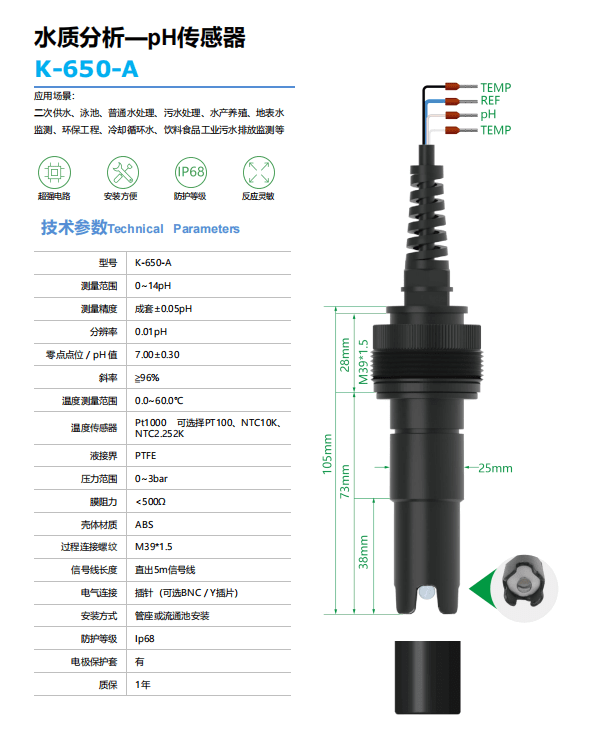
Unlike laboratory pH sensors, industrial models are designed for long-term continuous operation in harsh environments with impurities, corrosion, and temperature fluctuations. Standardized installation, calibration, operation, and maintenance are critical to ensuring measurement accuracy and extending sensor service life. This user guide systematically introduces the core usage specifications of industrial pH sensors, covering pre-use inspection, standard installation steps, regular calibration methods, daily operation norms, routine maintenance, and common fault troubleshooting. It aims to provide practical and standardized operational guidance for industrial front-line operators and maintenance personnel, reduce equipment failure rates, guarantee stable and reliable long-term monitoring, and help enterprises meet industrial production and environmental monitoring standards.
1. Introduction
pH value is a key technical indicator in industrial production and water treatment processes. Slight pH deviation may cause product quality degradation, production equipment corrosion, or excessive pollutant discharge. Industrial pH sensors act as the core monitoring unit of online water quality analysis systems, undertaking the task of real-time, continuous and accurate pH detection. Due to the complex industrial working conditions including high temperature, strong acid and alkali, suspended sediments and long-term submerged operation, industrial pH sensors are prone to data drift, probe contamination and performance attenuation without standardized use. Therefore, mastering complete user specifications and maintenance skills is the premise to maximize sensor performance, ensure production stability and reduce operational costs.
2. Pre-use Inspection and Installation Specifications
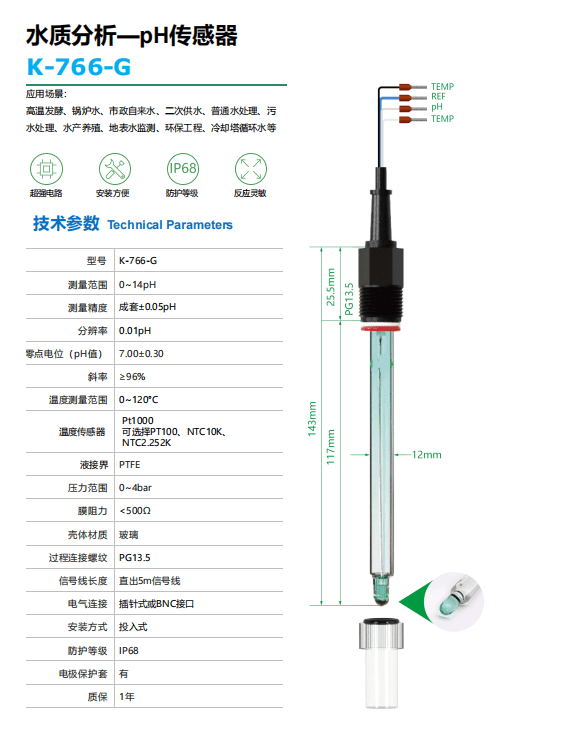
Complete pre-use inspection is the foundation of stable sensor operation. Before installation, users need to check the sensor appearance for cracks, damage or aging of the glass membrane and shell, and verify the integrity of cables and connectors to avoid circuit faults. Meanwhile, confirm that the sensor’s measurement range, temperature resistance grade and protection level match the actual industrial working conditions, especially for special scenarios such as high-temperature chemical reaction tanks and strong corrosive wastewater pools.
In terms of installation, industrial pH sensors support three mainstream modes: submerged installation, pipeline installation and wall-mounted installation. The installation position must avoid dead water zones, strong liquid impact areas and direct sunlight to prevent measurement interference. It is necessary to ensure the sensor probe is completely immersed in the monitored liquid, with no air bubbles attached to the glass membrane. In addition, the sensor should be installed vertically as much as possible to facilitate self-cleaning and reduce sediment adhesion, and reserved a certain distance from the tank wall and pipeline to avoid detection dead angles.
3. Standard Calibration and Operation Requirements
Calibration is the core step to ensure pH measurement accuracy, and industrial pH sensors require regular two-point or three-point calibration. The standard buffer solutions of pH 4.01, pH 6.86 and pH 9.18 are the most commonly used calibration reagents. Before calibration, clean the probe with pure water to remove surface impurities and wipe it gently with soft filter paper. The calibration sequence should follow the principle of neutral first and then acid-base, and ensure the buffer solution is kept at a constant temperature to reduce temperature deviation errors. After calibration, confirm that the sensor data returns to standard values before formal operation.
During daily operation, users should keep the sensor running continuously as frequent startup and shutdown will accelerate performance drift. For production processes with fluctuating water quality and temperature, it is necessary to enable the sensor’s automatic temperature compensation function to dynamically correct measurement data. It is forbidden to use the sensor beyond its temperature and pH measurement range, and avoid long-term contact with heavy metal pollutants and oily liquids that may cause irreversible damage to the glass membrane.
4. Daily Maintenance and Fault Troubleshooting
Scientific daily maintenance can effectively extend the service life of industrial pH sensors. Conventional cleaning should be carried out every 3 to 7 days according to water quality turbidity. For common sediment and sludge pollution, flush the probe with pure water; for oily and chemical scaling, use dilute neutral detergent for gentle cleaning, and never use sharp tools to scratch the probe surface. In low-frequency operation or shutdown state, the probe should be soaked in protective solution to prevent the glass membrane from drying and aging.
Common operational faults include unstable data, large measurement deviation and slow response. Unstable data is mostly caused by probe contamination or loose wiring, which can be solved by cleaning the probe and checking circuit connections. Large deviation usually results from overdue calibration, requiring immediate recalibration with standard buffer solutions. Slow response is generally due to glass membrane aging, and the sensor probe needs to be replaced in time if maintenance is ineffective.
5. Conclusion
Standardized use and maintenance are key to maintaining the high performance of industrial pH sensors. Strict pre-use inspection and standardized installation provide a basic guarantee for sensor operation, regular calibration and standardized daily operation ensure the accuracy and real-time of monitoring data, and scientific maintenance and timely fault handling effectively reduce equipment loss and operational costs. In industrial practical applications, operators should formulate targeted use and maintenance plans according to actual working condition characteristics. Standardized management of industrial pH sensors can not only stabilize production process parameters and improve product quality, but also ensure that industrial wastewater discharge meets environmental protection standards, bringing dual economic and environmental benefits to industrial production.
Scan the QR code to receive more detailed information.