This article systematically summarizes practical and professional maintenance techniques for wastewater pH sensors, covering daily cleaning, regular calibration, aging component replacement and environmental adaptive maintenance. It also analyzes common operational faults and corresponding troubleshooting methods. The study aims to provide reliable technical guidelines for wastewater treatment personnel, reduce equipment failure rates, extend sensor service life, and guarantee the stability and authenticity of wastewater pH monitoring data.
1. Introduction
pH value is a critical control indicator in wastewater treatment processes. Appropriate pH conditions ensure the normal activity of microbial flora in biochemical tanks, improve the efficiency of coagulation and disinfection processes, and help enterprises meet national wastewater discharge standards. Wastewater pH sensors mainly rely on glass membrane potential response to collect data, but the complex composition of industrial and domestic wastewater easily causes fouling and damage to the sensor’s sensitive electrode. Without scientific maintenance, sensors will suffer from slow response, large measurement errors and even complete failure, leading to abnormal process adjustment and unqualified effluent water quality. Therefore, mastering standardized maintenance techniques is a key link in the stable operation of wastewater water quality monitoring systems.
2. Daily Cleaning and Routine Maintenance
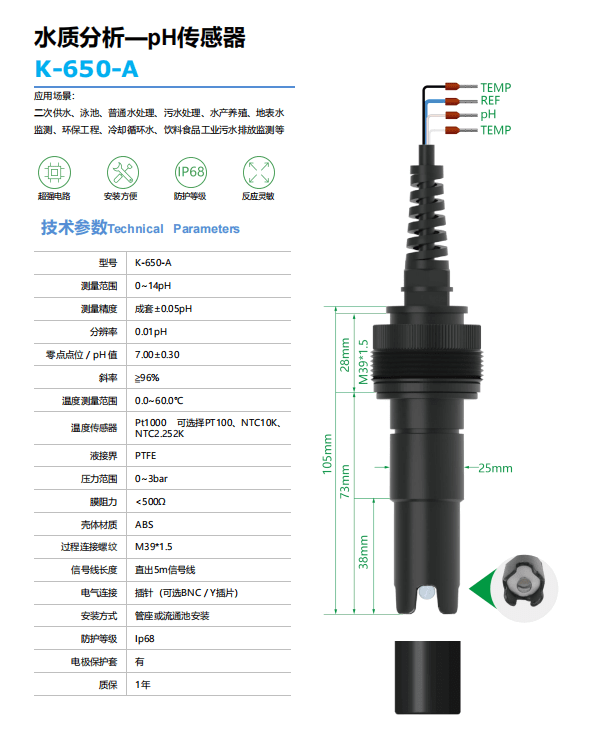
Daily cleaning is the most basic and frequent maintenance work for wastewater pH sensors, which can effectively prevent permanent contamination of the glass electrode. Wastewater contains a large amount of sludge, grease, colloidal particles and organic sediments that easily adhere to the sensor surface, blocking hydrogen ion exchange and reducing measurement sensitivity. For conventional surface fouling, regular flushing with clean water is recommended during daily inspections. For oil stains and viscous organic attachments, dilute neutral detergent or mild ethanol solution can be used for soft wiping, avoiding hard brushes and corrosive strong acid or alkali reagents that may scratch or corrode the glass membrane.
In addition to cleaning, routine inspection includes checking sensor installation stability, cable integrity and water permeability of the protective sleeve. The sensor should be fixed at a reasonable water depth to avoid exposure to the air or long-term immersion in sediment accumulation areas. Damaged cables and loose interfaces should be replaced and tightened in time to prevent signal interference and water ingress damage.
3. Regular Calibration Maintenance Technology
Calibration is the core maintenance procedure to eliminate pH sensor measurement errors. Affected by electrode aging and environmental interference, sensor potential deviation will gradually increase during long-term operation, making regular calibration indispensable. For wastewater treatment scenarios with severe water quality interference, a two-point calibration method using standard buffer solutions (pH 4.01 and pH 9.21) is adopted, covering both acidic and alkaline wastewater monitoring ranges.
The calibration process follows strict standardized steps. First, clean the sensor electrode with distilled water and dry it gently with filter paper. Then immerse it in the standard buffer solution in sequence for steady reading and parameter correction. It is necessary to ensure the buffer solution is fresh and uncontaminated, and replace the expired solution regularly. Under normal operating conditions, wastewater pH sensors require calibration every 7 to 14 days; for high-pollution industrial wastewater environments, the calibration cycle should be shortened to 3 to 5 days to ensure data accuracy.
4. Fault Maintenance and Aging Replacement
Common faults of wastewater pH sensors include slow response, unstable data and fixed-value deviation. Slow response is mostly caused by electrode membrane fouling or dehydration, which can be solved by deep cleaning and activation with soaking solution. Unstable data is generally attributed to loose wiring, water intrusion in the transmitter or excessive water temperature fluctuation, which requires circuit inspection and environmental adjustment. If the sensor still has large errors after cleaning and calibration, it indicates electrode aging and failure.
The service life of wastewater pH sensors is usually 6 to 12 months due to harsh operating conditions. When the electrode glass membrane ages, becomes brittle or fails to respond effectively to hydrogen ions, the sensor must be replaced in a timely manner. Regular replacement of aging accessories can avoid long-term data distortion and ensure the continuous and stable operation of the monitoring system.
5. Conclusion
Effective maintenance techniques are the guarantee for the stable and accurate operation of wastewater pH sensors. Scientific daily cleaning can prevent electrode contamination, standardized regular calibration can eliminate measurement deviation, and timely fault troubleshooting and aging replacement can reduce equipment failure risks. Targeted maintenance measures adapted to complex wastewater environments can significantly extend sensor service life, improve monitoring precision, and provide accurate data support for the precise operation and efficient management of wastewater treatment systems. Standardizing sensor maintenance procedures is of great significance for ensuring stable effluent quality and reducing enterprise operation and maintenance costs.
Scan the QR code to receive more detailed information.