Different from small-diameter flowmeters, large-diameter models are optimized for low flow velocity, large flux, and long-term continuous operation scenarios, with outstanding advantages of zero pressure loss, strong anti-interference ability, and stable long-term operation. This paper systematically introduces the working principle and structural characteristics of large-diameter electromagnetic flowmeters, analyzes their core advantages and mainstream industrial application scenarios, summarizes existing technical limitations in practical operation, and explores future optimization and development directions. The research aims to provide theoretical and practical references for the popularization and performance upgrading of large-caliber flow measurement equipment in large-scale engineering projects.
1. Introduction
Flow measurement is a fundamental guarantee for the stable operation and efficient management of fluid transportation systems, especially for large-diameter pipelines widely used in urban water supply, industrial drainage, and water conservancy diversion projects. The measurement accuracy and operational stability of flowmeters directly determine the precision of engineering scheduling, energy consumption statistics, and pipeline leakage monitoring. Traditional large-diameter flow measurement equipment, such as turbine and ultrasonic flowmeters, has prominent defects: turbine flowmeters are prone to mechanical wear under long-term high-flow operation, while ultrasonic flowmeters are easily affected by fluid impurities and pipeline vibration. As a high-performance special measuring device, the large-diameter electromagnetic flowmeter perfectly adapts to the operating characteristics of large-caliber pipelines and has gradually become the mainstream metering equipment for large-scale fluid engineering.
2. Working Principle and Structural Features
The working principle of large-diameter electromagnetic flowmeters follows Faraday’s electromagnetic induction law. When a conductive fluid passes through the uniform magnetic field generated by the instrument’s excitation coil, the fluid cuts the magnetic induction lines, inducing a stable induced electromotive force proportional to the average flow velocity. The high-sensitivity electrodes installed on both sides of the pipeline capture the electrical signal, and the internal processor converts the signal into accurate instantaneous and cumulative flow data through algorithm calculation.
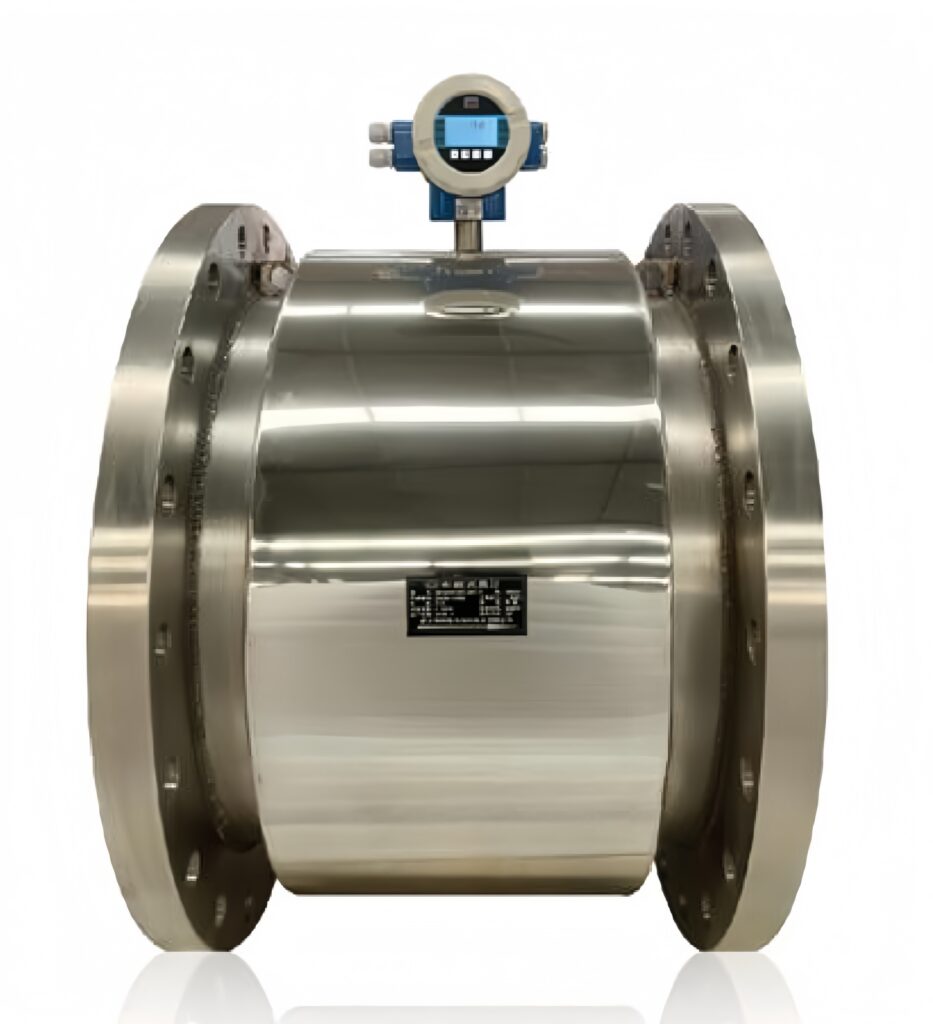
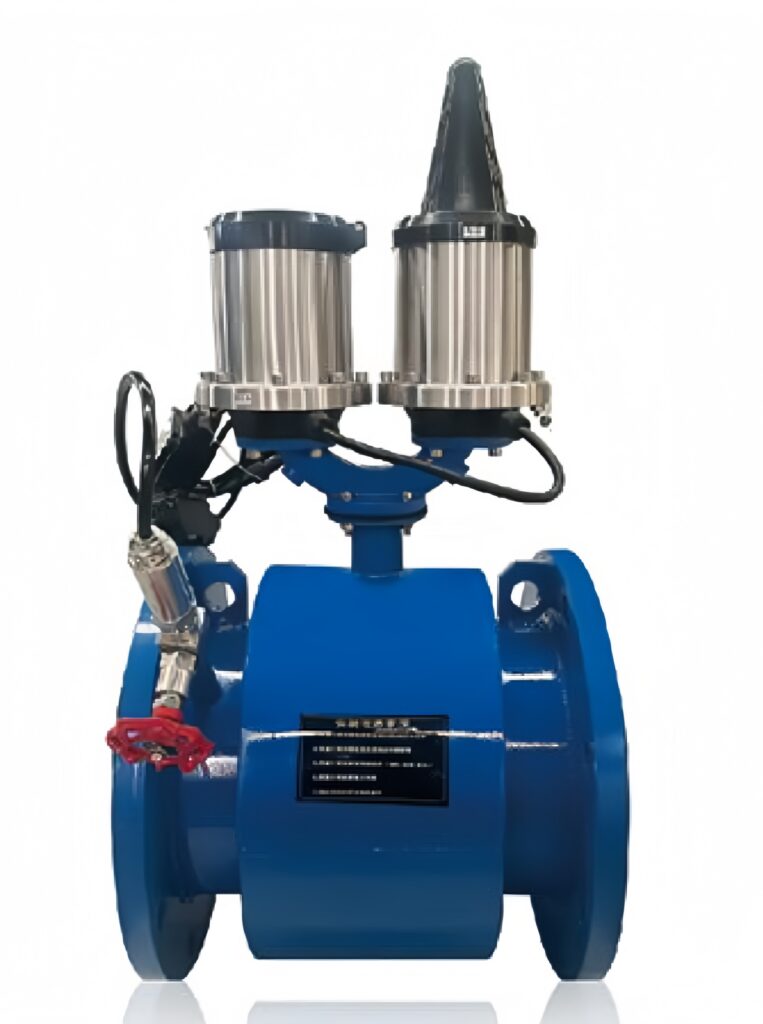
In terms of structural design, large-diameter models adopt an integrated or split anti-corrosion structure suitable for pipelines with a diameter of more than 300 millimeters. Compared with small-diameter electromagnetic flowmeters, they are equipped with enhanced excitation modules to ensure uniform magnetic field distribution in large-caliber pipelines, effectively avoiding measurement errors caused by uneven fluid flow. The lining materials are optimized with high wear resistance and anti-corrosion performance to adapt to complex fluid media containing sediment and impurities, meeting the requirements of long-term uninterrupted operation in harsh engineering environments.
3. Core Advantages and Practical Applications
Large-diameter electromagnetic flowmeters have irreplaceable technical advantages in large-scale engineering scenarios. Firstly, the equipment has no movable mechanical parts, resulting in almost no mechanical wear and extremely low failure rate, which greatly reduces later maintenance costs and downtime losses. Secondly, it causes zero pressure loss during operation, avoiding fluid energy loss caused by pipeline resistance, which is of great significance for energy conservation in long-distance water transportation projects. In addition, it has a wide measurement range and stable performance, and its measurement accuracy is not affected by fluid temperature, pressure, viscosity, and solid particle content, adapting to tap water, industrial wastewater, chemical conductive liquid and other diverse media.
In practical engineering, the equipment is most widely used in municipal water supply and drainage systems, responsible for flow metering and real-time monitoring of urban main water pipelines. In hydraulic engineering, it is applied to water diversion, flood discharge and reservoir flow monitoring to support scientific water resource scheduling. In heavy industries such as steel, chemical and papermaking, it accurately measures industrial circulating water and wastewater discharge, helping enterprises realize production parameter optimization and environmental emission standard monitoring.
4. Limitations and Future Development Trends
Restricted by technical and structural factors, large-diameter electromagnetic flowmeters still have certain application limitations. The equipment can only measure conductive fluids and cannot adapt to non-conductive media such as pure water and gas. Meanwhile, the large-volume and high-precision manufacturing process leads to high production and installation costs. In addition, long-term operation in strong electromagnetic interference environments may cause signal drift and affect measurement stability.
With the development of intelligent engineering technology, large-diameter electromagnetic flowmeters are evolving towards intelligence, miniaturization of accessories and high anti-interference performance. Future optimization focuses on intelligent self-diagnosis and self-calibration functions to automatically correct signal errors and reduce manual maintenance frequency. Moreover, combining Internet of Things technology to realize remote data transmission, real-time fault early warning and cloud data analysis will further improve the intelligent management level of large-scale fluid engineering. The adoption of new composite lining materials will also enhance the equipment’s adaptability to extreme working conditions.
5. Conclusion
As professional metering equipment for large-caliber pipeline fluid measurement, large-diameter electromagnetic flowmeters rely on their stable performance, zero pressure loss and low maintenance cost to fill the technical gap of traditional flow measurement equipment in large-scale engineering scenarios. It plays a vital role in municipal engineering, water conservancy construction and industrial production monitoring. Although it is limited by medium adaptability and manufacturing cost at the present stage, continuous technological innovation and structural optimization will effectively make up for these shortcomings. In the future, intelligent and integrated large-diameter electromagnetic flowmeters will become the core measuring equipment of smart water affairs and intelligent industrial systems, with broad application prospects and high engineering practical value.
Scan the QR code to receive more detailed information.