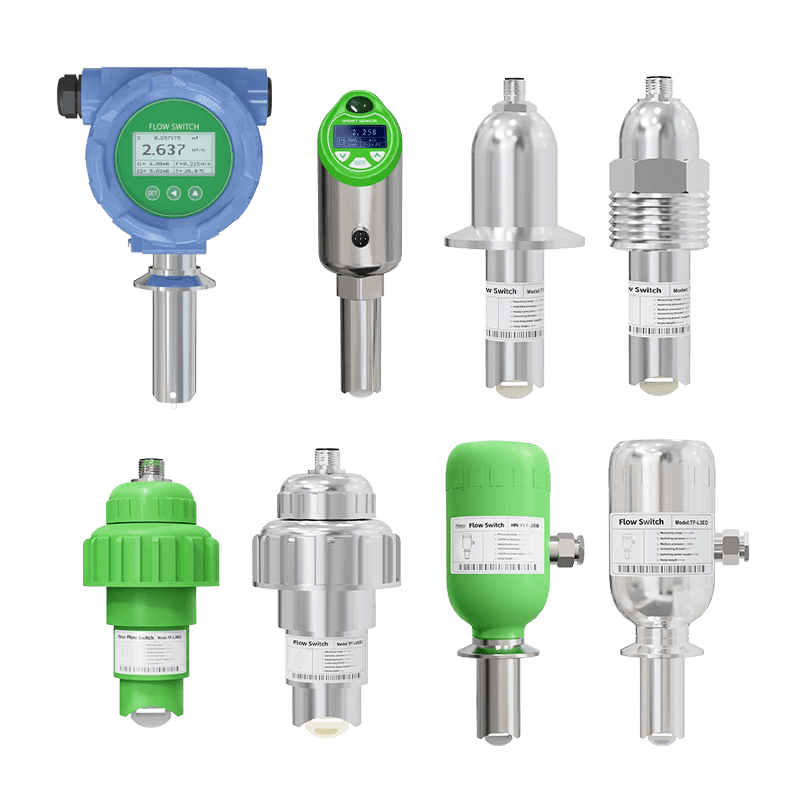
Essentially, vortex flow meters only measure real-time volumetric flow under on-site working conditions instead of standard flow or mass flow. For compressible media including industrial gas and steam, density varies drastically with temperature and pressure fluctuations, making compensation indispensable for credible data. This article clarifies the working principle differences between compensated and non-compensated applications, analyzes typical error risks caused by omitted correction, distinguishes applicable scenarios for non-compensation use, and provides standardized configuration guidelines. It helps buyers avoid stereotyped misunderstandings and achieve compliant, high-precision flow measurement.
1. Introduction
Vortex flow meters are widely used for gas, steam and liquid flow monitoring due to their simple structure, no moving parts, low pressure loss and stable signal output. To reduce procurement costs and simplify system wiring, many suppliers promote the claim that vortex meters require no temperature and pressure compensation. As a result, a large number of purchasers blindly adopt non-compensation models for all working conditions without medium classification. In practical industrial operation, this wrong cognition has become one of the main causes of long-term hidden measurement errors. While non-compensated vortex meters are feasible for conventional liquid monitoring, omitting compensation for gas and steam will lead to continuous data drift, affecting process control accuracy, energy balance accounting and commercial metering fairness.
2. Essential Principle: Working Flow vs Standard Flow
The core misunderstanding originates from the confusion between working volumetric flow and standard volumetric flow. Vortex flow meters calculate flow rate based on Karman vortex street frequency, which directly reflects the real-time flow volume under current temperature and pressure. For incompressible liquid media, density changes caused by temperature and pressure fluctuations are extremely small, and working flow data can represent actual flow conditions stably. Therefore, liquid measurement allows non-compensation configuration. However, gas and steam are typical compressible media. Minor changes in pressure and temperature will cause significant density variation. Without real-time compensation conversion, the measured working volume cannot be converted into standard volume or mass flow recognized by industrial and national metering standards, resulting in invalid statistical data.
3. Practical Losses Caused by Abolishing Compensation
For industrial gas pipelines with frequent load fluctuations, the measurement error of non-compensated vortex meters can reach 8% to 15% throughout the year. In peak production periods with high temperature and low pressure, the meter will undercount flow data; in low-temperature and high-pressure environments, it will cause overcounting deviations. For steam metering scenarios widely used in thermal power, chemical heating and central heating projects, the error is more serious. Steam density is extremely sensitive to temperature and pressure changes. Lack of dynamic compensation will lead to disordered energy consumption statistics, inaccurate production cost accounting and even commercial billing disputes between enterprises and energy suppliers.
In addition, long-term uncompensated data deviation will interfere with process parameter adjustment. Inaccurate gas and steam flow feedback makes it impossible for the automatic control system to form precise closed-loop regulation, resulting in unstable production conditions, increased unit energy consumption and reduced product qualification rate. Many enterprises attribute low energy efficiency to equipment aging, while ignoring measurement errors caused by incorrect instrument configuration.
4. Scientific Configuration Principles for Compensation
Industrial users and purchasers must establish differentiated configuration logic based on medium attributes. Clean water and other incompressible stable liquids can adopt ordinary non-compensation vortex meters to control costs reasonably. For all compressible gaseous media, saturated steam and superheated steam used for process monitoring, energy statistics and custody transfer, integrated temperature and pressure compensation modules are mandatory. The compensation system can collect real-time medium temperature and pressure parameters, automatically correct density differences, and convert working flow into standard flow and mass flow, ensuring data traceability and compliance.
5. Conclusion
The claim that vortex flow meters need no temperature and pressure compensation is a typical one-sided industry misunderstanding that has misled countless purchasers. Non-compensation technology is only applicable to liquid working conditions, rather than universal configuration for all media. For gas and steam measurement, blind cancellation of compensation will cause huge measurement deviations, economic losses and management confusion. Industrial buyers should abandon stereotyped cognition, match compensation schemes according to medium characteristics and application purposes, and standardize instrument selection and system configuration. Correct temperature and pressure compensation matching is essential to ensure long-term accurate, stable and compliant operation of vortex flow meter measurement systems.
Scan the QR code to receive more detailed information.