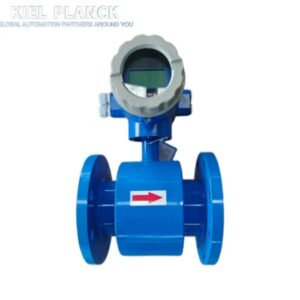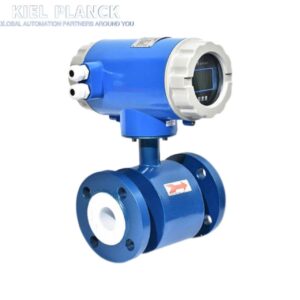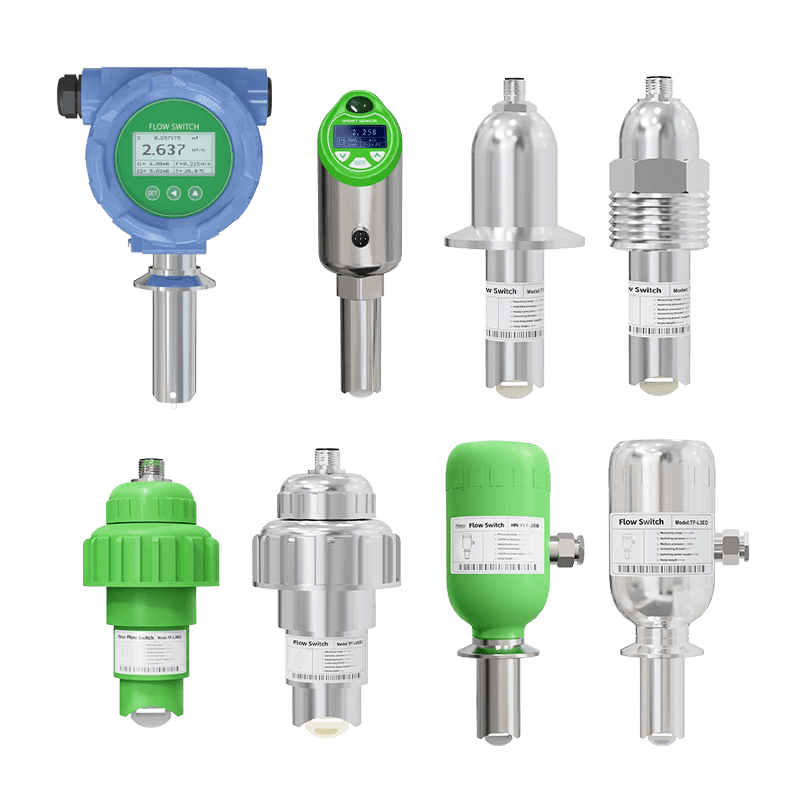
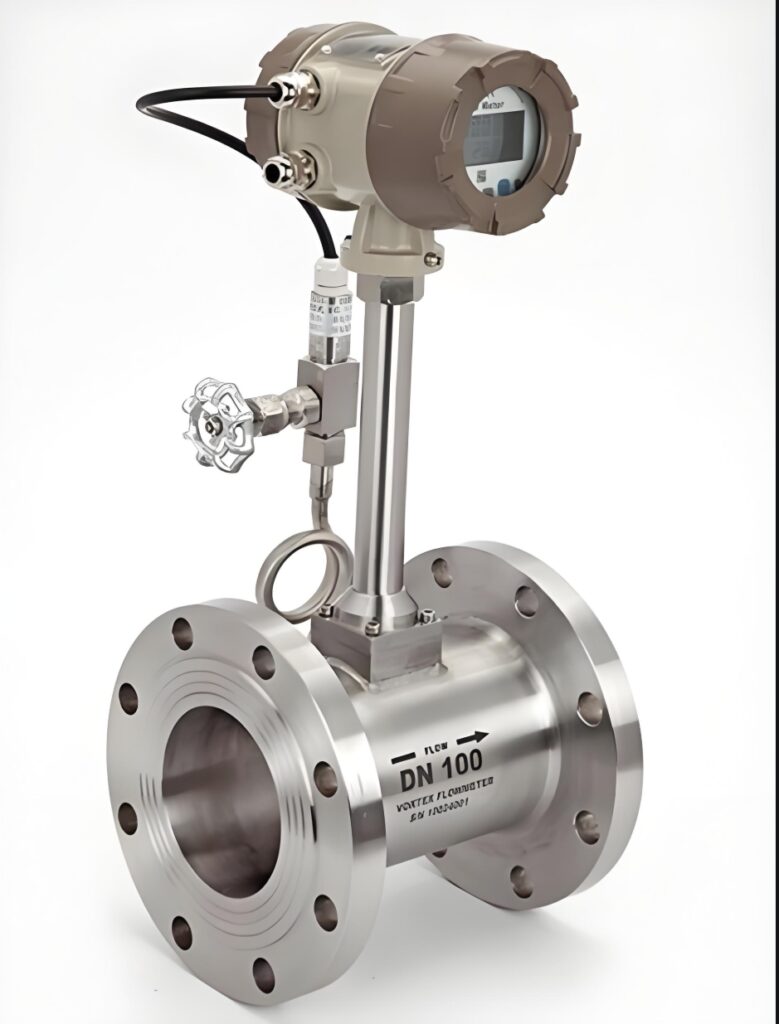
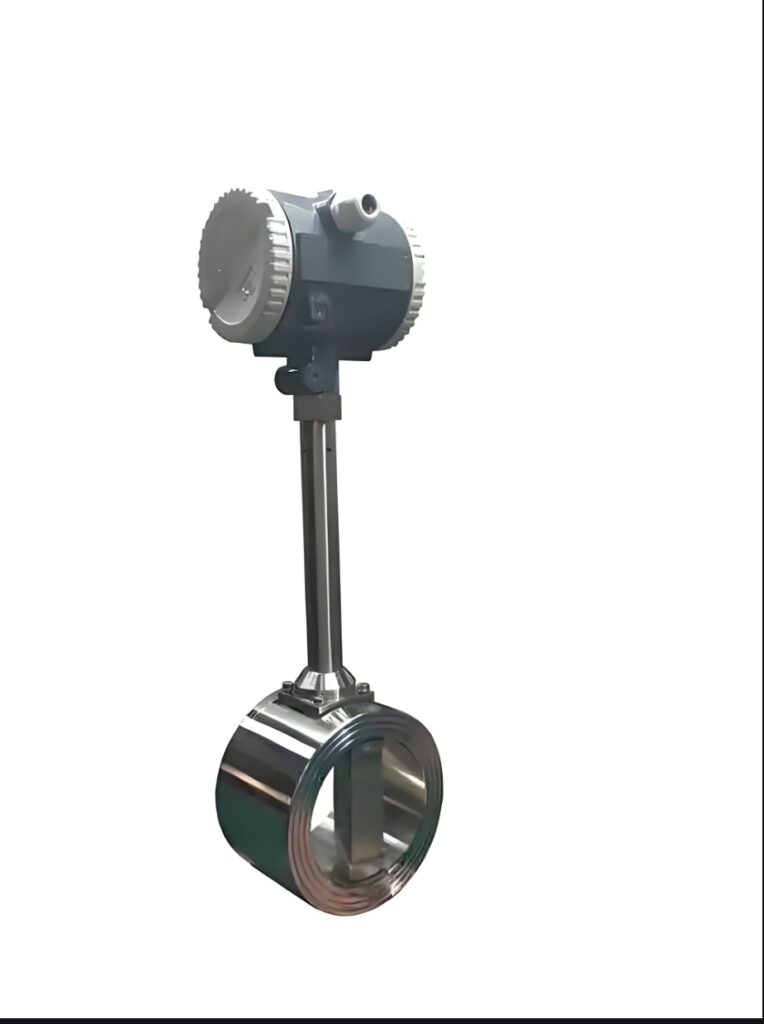
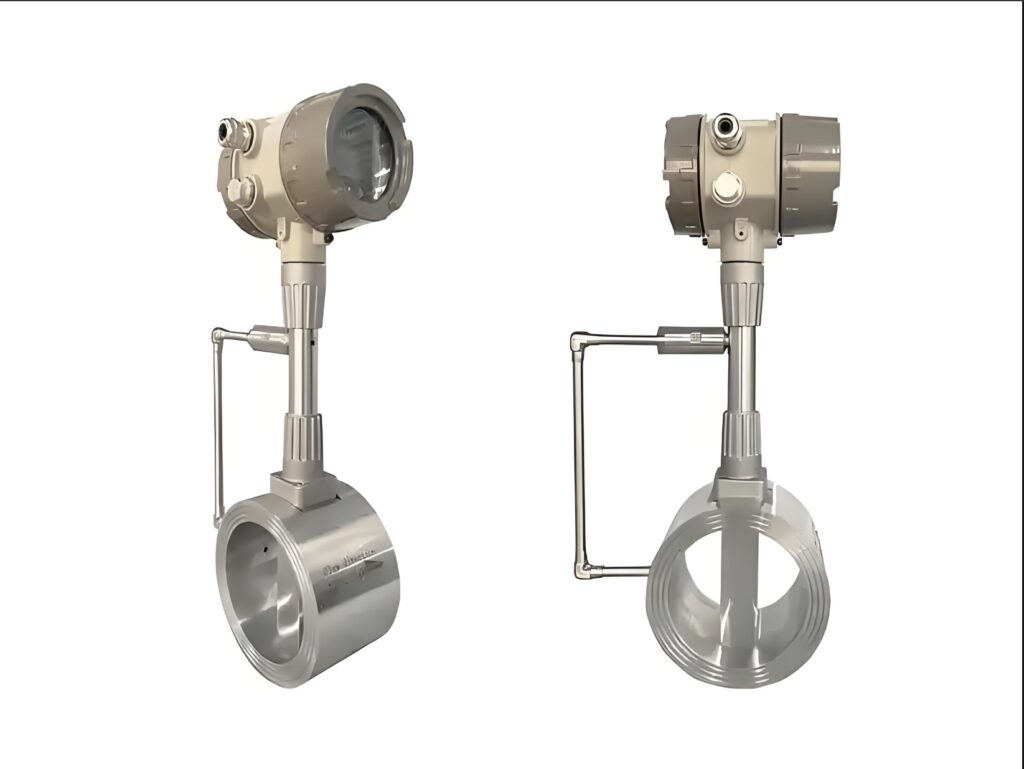
Vortex flow meters have low pressure loss, wide range, are maintenance-free, and are easy to install; LGB orifice plate throttling devices are low in cost and resistant to high and low temperatures and high pressures, but have high pressure loss, narrow range, and are complicated to install and maintain.
I. Principles and Signal Methods
**LGB Vortex Flow Meter**
Principle: Karman vortex street – Fluid flows through a triangular prism generator, generating alternating regular vortices downstream; the vortex frequency is proportional to the flow velocity.
Signal: Piezoelectric/capacitive sensor detects the frequency, directly outputting a pulse/frequency signal with good linearity.
Flow Relationship: Q = K⋅f (K is the instrument coefficient, an approximate constant).
**LGB Throttling Device (Orifice Plate)**
Principle: Differential pressure throttling – Fluid contracts as it passes through the orifice plate, increasing velocity and decreasing static pressure, creating a differential pressure ΔP.
Signal: Differential pressure transmitter measures ΔP; the square root is used to obtain the flow rate; non-linear.
Flow Relationship: Q = K⋅ΔP (K is related to Reynolds number and orifice ratio).
2. Pressure Loss (Energy Consumption)
Vortex Slide: Low pressure loss, approximately 1/5 to 1/10 that of an orifice plate, resulting in significant energy savings.
LGB Orifice Plate: High pressure loss, consistently high pressure drop, leading to high energy consumption over long-term operation.
3. Media and Operating Condition Adaptability
Vortex Slide
Suitable for: Gases, steam, and clean, low-viscosity liquids.
Limitations: Not suitable for low flow rates (liquids ≥ 0.5 m/s, gases ≥ 5 m/s); poor vibration resistance; not suitable for flows containing large amounts of solids/viscous substances/two-phase flows.
LGB Orifice Plate
Suitable for: Almost all single-phase media (gases, steam, liquids), resistant to high temperatures (-185~+650℃) and high pressures (≤32 MPa), and can contain a small amount of particles.
Limitations: Poor accuracy at low flow rates; narrow flow range.
III. Installation and Maintenance
1. Straight Pipe Section Requirements
Vortex Street: 10D upstream, 5D downstream; 15-20D if there is an elbow/valve upstream.
LGB Orifice Plate: 20-40D upstream, 5D downstream; stricter requirements for straight pipe sections.
2. Installation Complexity
Vortex Street: Integrated design, no need for pressure guide pipes or three-valve manifolds, direct flange connection, fewer leakage points.
LGB Orifice Plate: Requires orifice plate + annular chamber + pressure guide pipe + three-valve manifold + differential pressure transmitter, complex installation, more leakage points.
3. Maintenance Requirement and Lifespan
Vortex Street: No moving parts, no wear, maintenance-free, long lifespan (10+ years); simple cleaning is sufficient when the sensor is contaminated.
LGB Orifice Plate: Sharp angles of the orifice plate are prone to wear and scaling, requiring regular disassembly and cleaning; pressure guide pipes are prone to blockage/freezing/leakage, requiring frequent maintenance; differential pressure transmitter requires regular calibration.
IV. Cost Comparison
Vortex Flow Meter
Instrument Price: Moderate (including sensor + converter).
Installation Cost: Low (no pressure guide pipe/three-valve manifold required).
Operating Cost: Low (low pressure loss, energy saving).
Maintenance Cost: Extremely low (maintenance-free).
LGB Orifice Plate
Instrument Price: Low (orifice plate is inexpensive), but requires separate purchase of differential pressure transmitter + integrator.
Installation Cost: High (pressure guide pipe, three-valve manifold, welding/laying).
Operating Cost: High (high pressure loss, high energy consumption).
Maintenance Cost: High (regular cleaning, calibration, leak sealing).
V. Recommended Application Scenarios
Vortex Flow Meter Preferred
Steam/Gas Metering (boilers, heating networks, compressed air, natural gas).
Large flow fluctuations, wide range requirements (1:10 or higher).
Energy saving is important, low long-term operating costs are desirable.
Limited maintenance manpower, maintenance-free operation is preferred.
Medium to low diameter (DN20~DN300), medium to high flow velocity.
LGB throttling device (orifice plate) preferred.
Extreme operating conditions: ultra-high temperature (>400℃), ultra-high pressure (>10MPa).
Large diameter (DN400 and above), low flow velocity (insufficient vortex street resolution).
Contains a small amount of solid particles, viscous (not severely so).
Extremely low budget, short-term use, non-trade settlement.
A large number of differential pressure transmitters already exist; reuse is required.
VI. Key Differences in One Sentence
Vortex Street: Linear, low pressure loss, wide range, maintenance-free, mid-to-high cost – Preferred for modern steam/gas applications.
LGB Orifice Plate: Nonlinear, high pressure loss, narrow range, high maintenance, low cost – Used for extreme conditions/large diameters/very low budgets.
Please contact us promptly if needed.