This paper elaborates on the inherent working principle differences among the three radar frequency bands, analyzes their respective performance characteristics, and proposes targeted selection criteria for different tank working conditions such as large storage tanks, narrow vessels, dusty environments and high-precision measurement scenarios. The research provides a clear and practical selection basis for industrial radar level measurement configuration.
1. Introduction
With the upgrading of industrial intelligent measurement, high-frequency radar level meters have gradually replaced traditional low-precision measuring equipment. Frequency band is the core factor determining the measurement performance of non-contact radar. 6GHz, 26GHz and 80GHz radars cover low, medium and high industrial frequency bands respectively. Their differences in physical properties and signal mechanisms directly affect the stability and accuracy of tank level monitoring. Reasonable frequency selection according to tank size, medium characteristics and on-site interference conditions is the key to ensuring long-term reliable operation of measuring equipment.
2. Fundamental Principle Differences of Three Frequency Bands
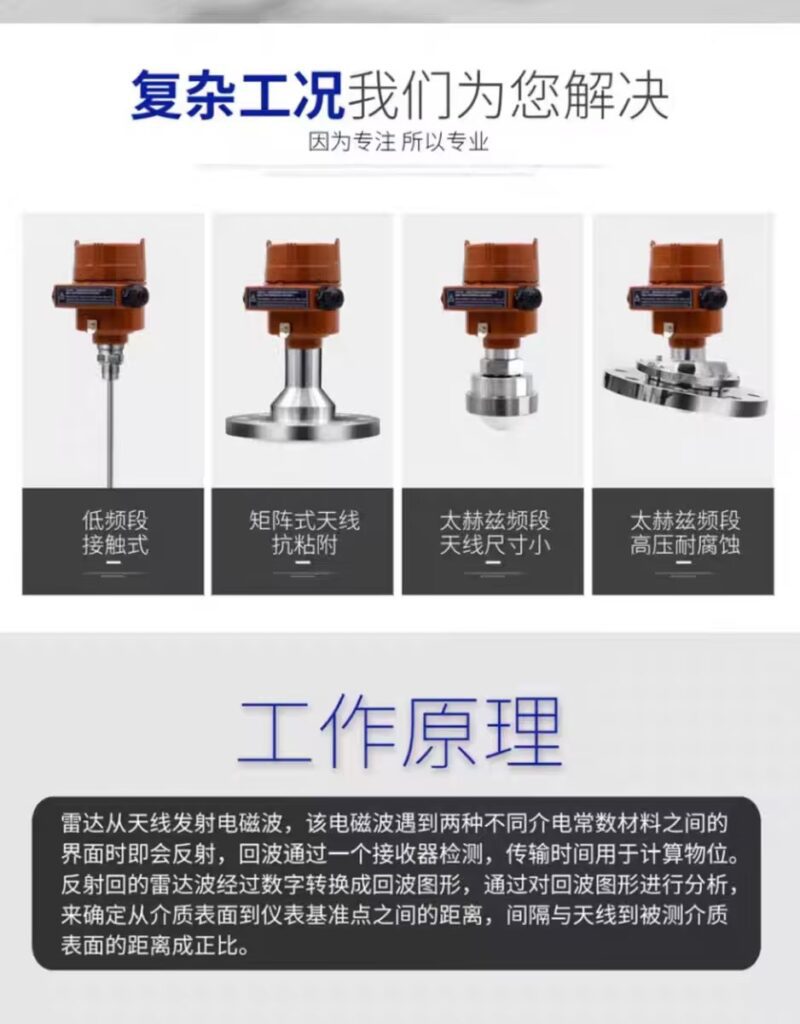
The core differences of the three radar bands stem from wavelength, beam angle and signal propagation characteristics. 6GHz radar belongs to low-frequency microwave with a long wavelength and wide beam angle. Its microwave signal has strong diffraction and penetration capabilities, and can effectively bypass obstacles and penetrate thick steam and dust layers. However, due to low signal resolution and wide beam coverage, it is prone to receive interference echoes from tank walls and internal structures, resulting in relatively low measurement accuracy.
26GHz is the most versatile medium-frequency radar. It balances wavelength, beam angle and anti-interference performance. With moderate signal energy and resolution, it avoids the excessive interference susceptibility of low-frequency radar and the environmental sensitivity of ultra-high frequency radar. It features stable propagation and balanced comprehensive performance, making it a universal choice for most conventional industrial measurement scenarios.
80GHz is a millimeter-wave ultra-high frequency radar with an extremely short wavelength and ultra-narrow beam angle. Its signal energy is highly concentrated, with ultra-high measurement resolution and positioning accuracy. The narrow beam effectively avoids tank wall interference and is suitable for precise measurement in complex structures. Nevertheless, high-frequency millimeter waves have poor penetration for thick dust and heavy steam, leading to performance attenuation in harsh interfering environments.
3. Working Condition Selection Strategy for Different Tanks
6GHz radar is suitable for large-scale open storage tanks and harsh working conditions with severe steam, thick dust and complex internal obstacles. Typical scenarios include large crude oil storage tanks, sewage sedimentation tanks and bulk material silos. Its strong signal penetration and diffraction ability can maintain stable measurement in high-interference environments, and it adapts to long-distance measurement of more than 30 meters with low precision requirements.
26GHz radar is the preferred choice for conventional medium and small-sized sealed storage tanks, covering most chemical media, water treatment and general petrochemical tanks. It performs stably in conventional environments with slight steam and dust, and balances measurement accuracy and cost. It is suitable for medium-precision monitoring scenarios with moderate tank height and few internal obstacles, and has excellent cost performance and environmental adaptability.
80GHz ultra-high frequency radar is tailored for high-precision measurement and limited installation conditions. It is applicable to narrow-diameter tanks, short nozzles, reaction kettles with complex internal structures, and low-dielectric medium measurement scenarios such as liquefied gas and light oil. Its ultra-narrow beam effectively avoids interference from tank walls and internal components, meeting high-standard precision requirements for batching metering and custody transfer measurement. It is also ideal for food, pharmaceutical and fine chemical industries requiring high measurement accuracy.
4. Conclusion
In conclusion, 6G, 26G and 80G radar level meters have clear differentiated advantages in principle and application. 6G low-frequency radar focuses on strong anti-interference and long-distance stable measurement for harsh environments; 26G medium-frequency radar achieves balanced performance and is suitable for most conventional industrial tank working conditions; 80G ultra-high frequency radar is specialized in high-precision and narrow-space measurement scenarios. In practical industrial applications, frequency band selection should comprehensively consider tank structure, on-site interference degree, medium attributes and precision requirements, so as to maximize the measurement efficiency and stability of radar level meters.
Scan the QR code to receive more detailed information.