This paper comprehensively analyzes the core measurement principle of vortex flow meters, elaborates on the vortex shedding phenomenon and the linear correlation between vortex frequency and fluid flow velocity, and explains the signal detection and conversion mechanism of the meter. Meanwhile, it discusses key factors affecting measurement accuracy and applicable working conditions. The analysis shows that vortex flow meters rely on fluid hydrodynamic characteristics to realize real-time flow monitoring, with outstanding advantages in anti-interference and long-term operation stability, providing accurate and reliable data support for industrial flow control.
1. Introduction
Flow parameter is one of the most important basic parameters in industrial production process, and accurate flow measurement is the premise of precise process control, energy conservation and consumption reduction, and safe production. As a mainstream differential velocity flow measuring device, vortex flow meters make up for the defects of traditional mechanical flow meters such as easy wear, short service life and poor stability. Different from electromagnetic flow meters and turbine flow meters, vortex flow meters adopt a non-contact fluid measurement method, which is not affected by medium temperature, pressure and viscosity changes in a conventional range. Relying on the natural vortex shedding law of fluid, it converts fluid flow velocity into measurable electrical signals, realizing continuous and accurate flow measurement. This article systematically sorts out its measurement principle, working mechanism and practical application characteristics.
2. Core Hydrodynamic Principle: Vortex Shedding Phenomenon
The core theoretical basis of vortex flow meters is the Karman vortex street principle in fluid mechanics. When a bluff body vortex generator is vertically installed in a fluid pipeline, the fluid will be divided into two strands when passing through the generator. Due to the blocking effect of the bluff body, boundary layer separation occurs on both sides of the fluid, forming regular alternating vortices on the downstream side of the generator. These vortices are arranged in two parallel rows, which is called Karman vortex street.
In a stable fluid state, the shedding frequency of vortices has a strict linear positive correlation with the fluid flow velocity. The higher the fluid flow velocity, the faster the vortex shedding speed and the higher the frequency. A fixed proportional formula exists between vortex frequency, flow velocity and pipeline caliber. Within the effective Reynolds number range, the proportional coefficient is stable and basically unchanged, which provides a reliable theoretical basis for quantitative flow measurement. This stable linear relationship is the key to ensure the high-precision measurement of vortex flow meters.
3. Signal Detection and Flow Conversion Mechanism
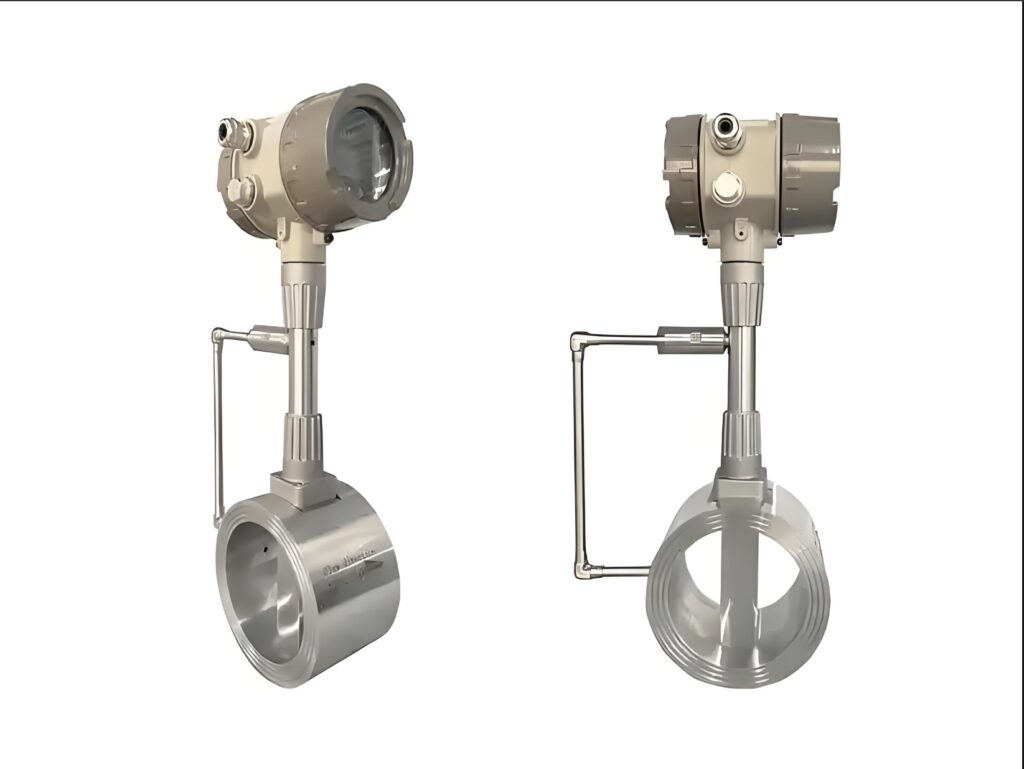
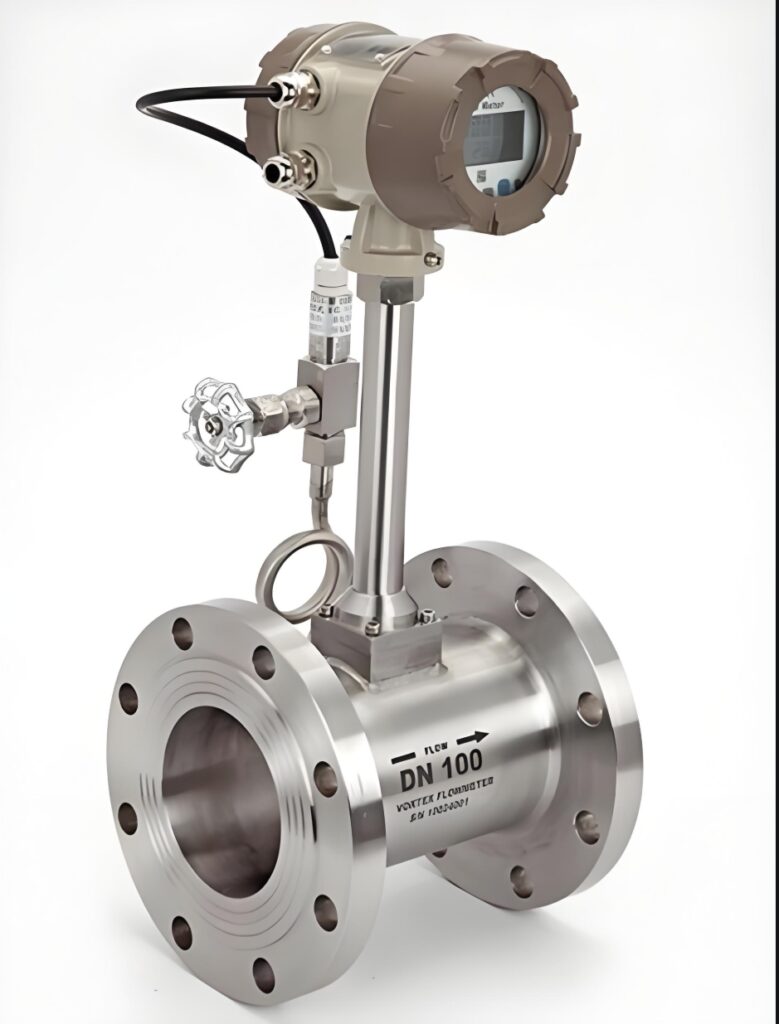
The complete measurement process of vortex flow meters includes vortex generation, signal detection, signal conversion and data output. After the vortices are alternately shed on both sides of the vortex generator, periodic pressure fluctuation and flow disturbance are generated in the pipeline. The built-in detection sensor of the meter can capture these regular physical changes in real time. Common detection technologies include piezoelectric detection, capacitive detection and ultrasonic detection, all of which can convert the periodic mechanical pressure changes caused by vortices into standard pulse electrical signals.
The frequency of the output pulse signal is completely consistent with the vortex shedding frequency. After the signal is amplified, filtered and calculated by the internal circuit and microprocessor, the instantaneous flow velocity of the fluid is obtained. Combined with the fixed cross-sectional area of the measured pipeline, the instrument can accurately calculate the instantaneous volume flow and cumulative flow of the medium, and finally output standard analog or digital signals to the control system to realize real-time flow monitoring.
4. Applicable Conditions and Measurement Advantages
Vortex flow meters have strict requirements on fluid stability, and the measurement accuracy can be guaranteed only when the fluid is in a turbulent state and the Reynolds number is within the specified range. They are suitable for measuring clean single-phase gas, liquid and steam media, and are not applicable for fluids with serious impurity deposition, high viscosity or unstable flow. Compared with other flow meters, it has prominent advantages: no mechanical moving parts, low failure rate and long service life; the measurement result is almost not affected by medium temperature, pressure and density changes; the structure is simple, the installation and maintenance cost is low, and the measurement linearity is good.
5. Conclusion
In summary, the measurement of vortex flow meters is based on the Karman vortex street principle of fluid mechanics. It realizes accurate flow measurement by capturing the linear relationship between vortex shedding frequency and fluid flow velocity, and converting hydrodynamic signals into electrical signals. The whole measurement process is scientific and efficient, with strong environmental adaptability and high measurement stability. Although restricted by fluid state and medium characteristics, it has irreplaceable application value in most conventional industrial flow measurement scenarios. In industrial production, standardizing installation conditions and maintaining stable fluid state can further give full play to the measurement advantages of vortex flow meters and ensure the accuracy and reliability of process flow data.
Scan the QR code to receive more detailed information.