This paper systematically expounds the importance of standard straight pipe section installation for vortex flow meters, specifies the standard length requirements of upstream and downstream straight pipes under different pipeline conditions, analyzes the measurement errors caused by insufficient straight pipe sections, and summarizes standardized installation specifications and rectification measures. Strict compliance with straight pipe section installation requirements can effectively optimize the fluid flow field, eliminate installation-induced errors, and ensure long-term accurate and stable operation of vortex flow meters in industrial scenarios.
1. Introduction
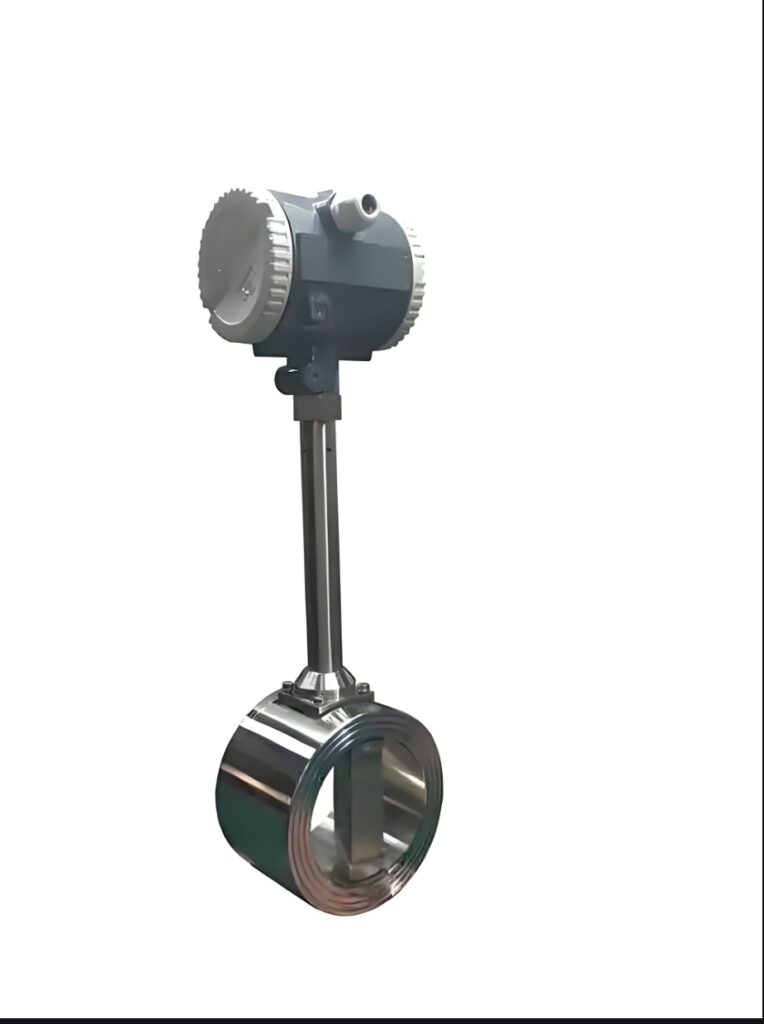
As a mainstream velocity-type measuring instrument, vortex flow meters are widely used for gas, liquid and steam flow measurement in petrochemical, thermal power, water treatment and other industries. Different from mechanical flow meters, their measurement principle depends entirely on the regular alternating vortex generated by stable fluid passing through the bluff body. In actual industrial pipelines, various pipe fittings will change the original laminar and turbulent state of the fluid, resulting in uneven flow velocity distribution and fluid swirling. If there is no sufficient straight pipe section before and after the meter, the disturbed fluid cannot return to a stable state, leading to irregular vortex shedding, signal fluctuation and persistent measurement deviation. Therefore, standardized straight pipe section installation is the primary prerequisite to eliminate installation errors and ensure the inherent measurement accuracy of vortex flow meters.
2. Working Mechanism of Straight Pipe Section for Flow Measurement
The core function of the straight pipe section is to stabilize the fluid flow field. When fluid passes through elbows, gate valves, tee joints and variable-diameter pipes, local flow separation, velocity gradient distortion and swirling flow will occur. These abnormal flow states will interfere with the vortex generation cycle of the vortex meter bluff body, resulting in unstable vortex shedding frequency, which further causes pulse signal disorder and reduces measurement linearity. A sufficient straight pipe section can eliminate fluid turbulence and swirling phenomenon through natural flow buffering, make the fluid form a uniform and axial stable flow field before entering the meter, and ensure the vortex street conforms to the standard Karman vortex distribution law, so that the flow velocity has a strict linear correlation with vortex frequency and guarantees accurate measurement data.
3. Standard Straight Pipe Section Installation Specifications
The straight pipe length requirements of vortex flow meters are divided into upstream and downstream standards, and the specific parameters vary with different upstream interference pipe fittings. Under standard working conditions with no special pipe fittings, the upstream straight pipe section shall not be less than 10 times the pipe diameter (10D), and the downstream straight pipe section shall not be less than 5 times the pipe diameter (5D), which meets the basic stable measurement requirements.
For complex interference working conditions, the straight pipe section length needs to be increased accordingly. After single 90-degree elbow and flat elbow, the upstream straight pipe section is required to reach 15D; after double elbows in different planes, the fluid swirling is serious, and the upstream straight pipe section must be guaranteed 20D. For partially opened regulating valves and reducing pipes, the upstream straight pipe section shall be no less than 25D. The downstream straight pipe section maintains a unified standard of 5D in most working conditions, which is mainly used to avoid backflow interference on the meter outlet flow field.
4. Measurement Errors Caused by Unqualified Straight Pipe Sections
Insufficient straight pipe sections will bring obvious systematic and random errors to vortex flow meters. Insufficient upstream straight pipe leads to incomplete fluid stabilization, uneven flow velocity distribution, and disordered vortex shedding, resulting in large fluctuation of instantaneous flow data and reduced measurement repeatability. In severe cases, swirling flow will cause the meter to generate false vortex signals, making the measured value continuously higher or lower than the actual flow rate. Insufficient downstream straight pipe will cause pipeline backflow and pressure fluctuation, interfere with the low-pressure side flow field of the bluff body, and affect the stability of vortex street arrangement. Relevant test data shows that when the straight pipe section is less than the standard requirement by 30%, the instrument measurement error will increase from ±1.0% to more than ±3.0%, which seriously fails to meet industrial metering standards.
5. Installation Optimization and Supplementary Measures
For on-site working conditions that cannot meet the standard straight pipe length due to space limitations, flow straighteners can be installed as an effective supplementary measure. The straightener can quickly eliminate fluid swirling and velocity deviation, shorten the fluid stabilization distance, and reduce the required straight pipe section length by more than half. In addition, during installation, the vortex meter shall be kept concentric with the pipeline, and no gasket protrusion or pipeline deformation is allowed at the connection port to avoid secondary flow field interference. Regular inspection of pipeline aging and deformation can ensure the long-term stability of the flow field and measurement accuracy.
6. Conclusion
Straight pipe section installation is the fundamental guarantee for the stable flow field and accurate measurement of vortex flow meters. The length of upstream and downstream straight pipes directly affects the vortex shedding state and signal stability, and unqualified installation will lead to irreversible measurement errors. Following unified industrial installation standards, matching straight pipe section lengths according to different pipeline interference conditions, and adopting flow straighteners for space-limited working conditions can effectively optimize the fluid operating state. Standardized straight pipe installation not only gives full play to the high-precision measurement performance of vortex flow meters, but also reduces later calibration and maintenance costs, providing reliable technical support for industrial flow metering and process stable operation.
Scan the QR code to receive more detailed information.