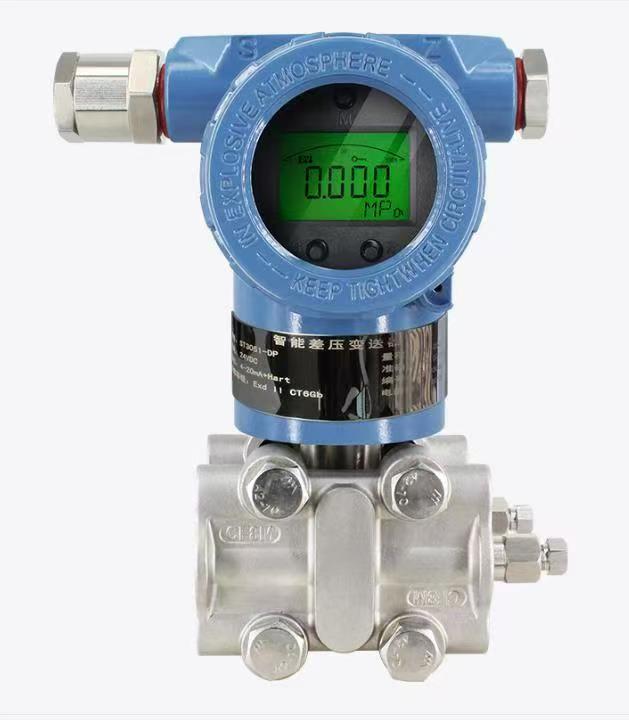
Dual-flange differential pressure level gauges are available in various models based on their measurement principle, functional characteristics, measurement range, and installation method. By selecting the appropriate model, different working conditions can be met, avoiding measurement errors or equipment damage caused by improper selection.
I. Core Model Classification
1. Classification by Functional Type
Dual-flange differential pressure level gauges are mainly divided into two categories: differential pressure type (DP) and pressure type (GP):
DP type (differential pressure type): Used for measuring liquid level, flow rate, and other scenarios requiring differential pressure parameters. It calculates the liquid level by measuring the pressure difference between the bottom and top of the container. Models typically end with “DP”, such as DS3851SLDP, SC-3051DP, YH1151DP, etc.
GP type (pressure type): Used for measuring the liquid level in sealed containers. It calculates the liquid level by measuring the static pressure at the bottom of the container. Models typically end with “GP”, such as DS3851SLGP, SC-3051GP, etc.
2. Classification by Intelligence Level
Non-intelligent type: Outputs a standard 4-20mA signal, without digital communication function. Models typically contain the “E” code, such as YH1151DP4E.
Intelligent type: Supports HART protocol, can be remotely configured and diagnosed, and the model usually contains the “S” code, such as YH1151DP4S.
1. High Temperature and High Pressure Models
High Temperature Type: Uses special high-temperature silicone oil (such as DC704), capable of handling media temperatures up to 316℃ or even higher. The model number may include “HT”.
High Pressure Type: Weifang Yafeng Instruments’ high-pressure differential pressure level gauges can withstand pressures up to 16MPa, suitable for high-pressure reactors in oil refining and coal chemical industries.
2. Explosion-Proof and Hygienic Models
Explosion-Proof Type: Depending on the explosion-proof rating, the model number may include “d” (explosion-proof) or “ia” (intrinsically safe). For example, in the model YH1151DP, “d” indicates explosion-proof type dIIBT4, while “ia” indicates intrinsically safe type iaIICT6.
Hygienic Type: Flat diaphragm design, meeting the cleanliness requirements of the food and pharmaceutical industries. The model number may include “Sanitary” or “Hygienic”.
Tips
Key Selection Points: When selecting a model, first determine whether you need to measure differential pressure or pressure. This determines whether to choose a DP or GP type.
Measuring Range Selection: The working pressure should be selected within 1/3 to 2/3 of the instrument’s range to ensure measurement accuracy and instrument lifespan.
Material Matching: When measuring strong acid and alkali media, special corrosion-resistant diaphragms should be selected, such as those made of Hastelloy or tantalum.
Capillary Length: The capillary length affects response speed and measurement accuracy. The appropriate length should be selected based on the site installation conditions.
Calibration Requirements: Newly installed or repaired instruments must be calibrated. Standard calibration points typically include 0%, 25%, 50%, 75%, and 100% of the range.
Avoid Vacuum: Dual-flange differential pressure level gauges are not suitable for vacuum applications because the filling liquid inside the capillary may vaporize, leading to measurement failure or even damage to the instrument.
When selecting a model, it is recommended to provide detailed operating parameters (medium, temperature, pressure, container size, etc.) to the supplier to obtain the most suitable model recommendation and avoid measurement errors or equipment damage due to improper selection.
Scan the QR code to receive more detailed information.