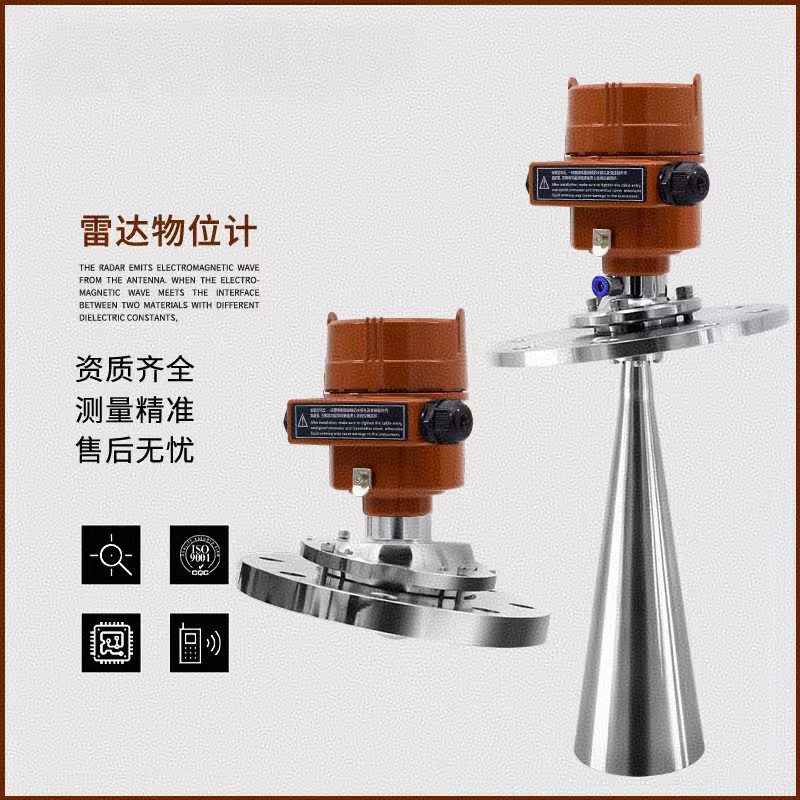
Radar level sensors achieve non-contact level measurement by transmitting, reflecting, and receiving microwave signals. They have significant advantages such as high precision, strong anti-interference, and adaptability to harsh environments, making them particularly suitable for complex working conditions such as chemical and petrochemical industries. However, they are relatively expensive and have certain limitations in measuring media with low dielectric constants.
I. Detailed Explanation of Measurement Principles
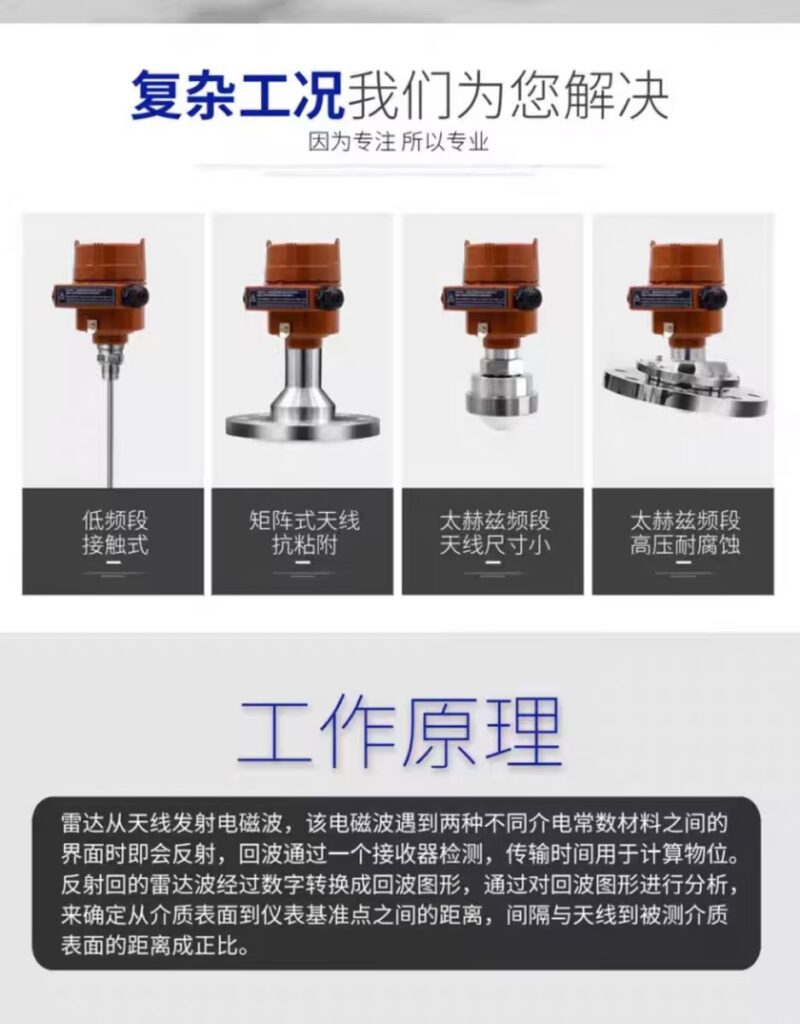
1. Basic Working Principle
* Core Formula: D = CT/2 (D: Distance from radar antenna to liquid surface, C: Speed of light, T: Electromagnetic wave travel time)
* Workflow: Radar level gauge antenna emits microwave pulses → Microwaves are reflected by the medium surface → The same antenna receives the reflected signal → Electronic components process the time difference → Liquid level height is calculated.
* Measurement Method: Employs pulse operation mode or FMCW frequency-modulated continuous wave technology, determining the distance by measuring the time difference between transmitted and received microwaves.
2. Technological Evolution and Accuracy Improvement
* Frequency Development: Evolved from early 6GHz → 26GHz → 80GHz high-frequency technology. Higher frequencies offer higher measurement accuracy and stronger anti-interference capabilities.
* Advantages of 80GHz Technology: Small beam angle (≤3°), concentrated energy, strong penetration, effectively avoiding obstacles inside the tank, particularly suitable for small-diameter containers and agitation conditions.
* Signal processing: Modern radar level gauges employ ZOOM-FFT and dynamic signal processing algorithms to identify true liquid surface echoes, enabling stable measurement even in foamy or steamy environments.
II. Core Advantages Analysis
1. Adaptability to Harsh Environments
* Wide Temperature Range: Adaptable to extreme temperature environments from -40℃ to 400℃, meeting the measurement needs of high-temperature reactors and low-temperature storage tanks.
* Strong Pressure Adaptability: Withstands pressure up to 40MPa, suitable for high-pressure pipelines and storage tanks.
* Corrosion-Resistant Design: Antenna materials include 316L stainless steel, Hastelloy, and PTFE, resisting corrosive media such as strong acids and alkalis.
* Suitable for Special Working Conditions: Provides stable measurements even in complex environments such as steam, foam, dust, and vigorous stirring.
2. High Precision and Stability
* High Measurement Accuracy: Modern high-frequency radar level gauges (80GHz) can achieve a measurement accuracy of ±1mm, far exceeding the ±5-10mm of ultrasonic level gauges.
* No Mechanical Wear: Non-contact measurement fundamentally solves the problem of equipment damage caused by corrosive and viscous media.
* Long-Term Stability: Unaffected by media density, viscosity, dust, and steam, exhibiting excellent measurement stability.
3. Safety and Convenience
* Safety Certifications: Some models are certified for explosion-proof (Ex d) and intrinsically safe (Ex ia) environments, suitable for use in explosive atmospheres.
* Easy Installation and Maintenance: Supports both top-mounted and side-mounted installation methods; calibration or replacement can be performed without production shutdown.
* Intelligent Diagnostic Functions: Supports remote debugging and status monitoring; can be integrated into DCS or PLC systems for intelligent management.
III. Limitations and Challenges
1. Price and Cost Factors
* High Initial Investment: Compared to ultrasonic level gauges, radar level gauges are more expensive, which is a major barrier to entry.
* Cost-Effectiveness Considerations: Ultrasonic level gauges remain competitive in simple operating conditions and low-cost applications.
2. Technological Limitations
* Blind Zone Issue: Although the blind zone of high-frequency radar has been reduced to a few centimeters, it still has a certain blind zone compared to other technologies.
* Low Dielectric Constant Media: Measurement results are poor for media with a dielectric constant less than 1.5 (such as liquid ammonia and liquid nitrogen), requiring special debugging or the use of guided wave radar.
* Antenna Contamination: If the antenna surface is contaminated with media, crystals, or ice, it can lead to measurement errors or even malfunctions.
3. Installation and Application Limitations
* Beam Path Requirements: During installation, it is necessary to ensure that the beam path is unobstructed, which has certain limitations for complex tank structures.
* Obstacles Inside the Tank: When installing near agitators, feed inlets, etc., special algorithms are required to avoid interference.
IV. Typical Application Scenarios
1. Scenarios where radar level gauges are preferred:
• High-temperature and high-pressure environments: such as reaction vessels, steam boilers, and other high-temperature and high-pressure applications
• Corrosive media: storage tanks for highly corrosive media such as hydrochloric acid and sodium hydroxide solutions
• Complex operating conditions: level measurement in environments with foam, steam, and high humidity.
High Safety Requirements: Suitable for applications requiring high safety and reliability, such as petrochemical tank farms and hazardous chemical storage tanks.
2. Scenarios Where Alternative Solutions Can Be Considered
• Low-Cost Water Pools/Channels: Budget-sensitive, open environments with low measurement accuracy requirements.
• Simple Operating Conditions: Conventional water treatment systems without steam, foam, or dust.
• Low-Risk Storage Tanks: Secondary locations with low requirements for measurement accuracy and continuity.
• V. Development Trends and Selection Recommendations
1. Technological Development Trends
• Domestic Production and Cost Reduction: With increased domestic production rates and technological maturity, high-performance domestic radar level gauges are now comparable to imported brands.
• Intelligent Upgrades: Integrating Bluetooth and wireless communication functions, supporting remote diagnostics and firmware upgrades.
• Widespread Adoption of High-Frequency Technology: 80GHz technology is becoming mainstream, further improving measurement accuracy and anti-interference capabilities.
2. Practical Selection Recommendations
• Media Characteristic Matching: For highly corrosive media, choose Hastelloy or PTFE antennas; for weakly corrosive media, 316L stainless steel antennas are suitable.
Frequency Selection: 6GHz for large-diameter storage tanks, 26GHz for general applications, and 80GHz for small-diameter containers.
* Installation Method: Top-mounted for vertical storage tanks, side-mounted for horizontal storage tanks or applications with limited overhead space.
* Signal Output: 4-20mA for basic requirements, RS485 (Modbus protocol) for intelligent applications.
* Radar level sensors, with their core advantages of non-contact measurement and strong anti-interference capabilities, have become a solution for level measurement in complex industrial environments, especially in industries such as chemical, petrochemical, and pharmaceutical manufacturing, where high accuracy and safety are required. With technological advancements and cost reductions, their application scope will further expand, gradually replacing traditional measurement methods and becoming the industry mainstream.