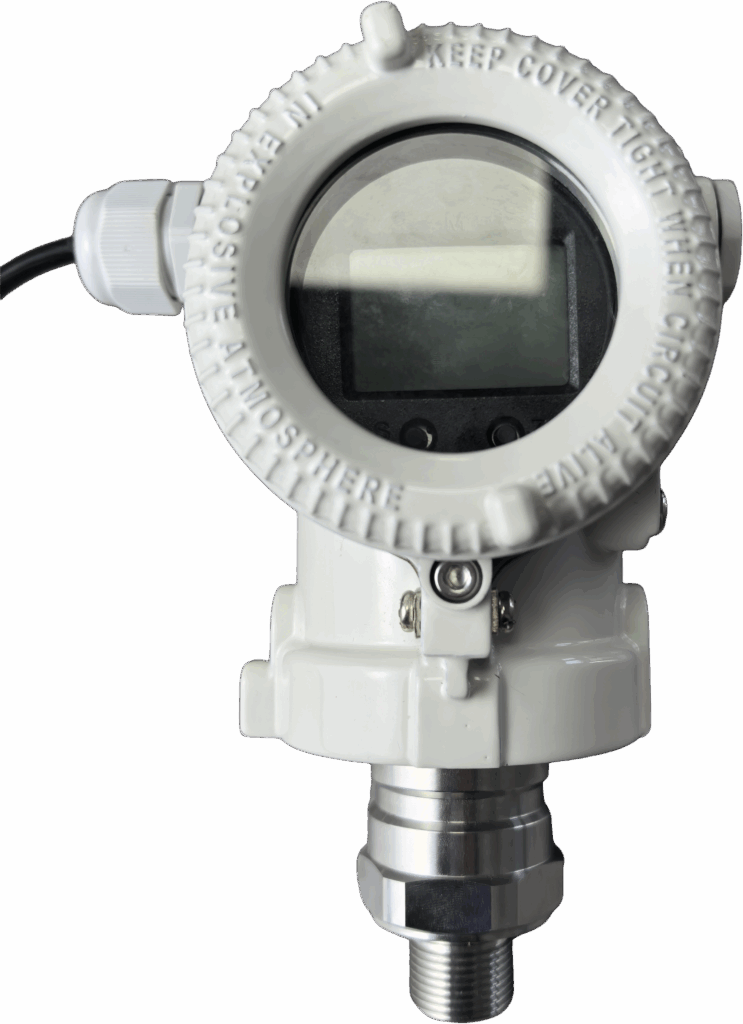
Core Technology Trends
**Leap in Accuracy and Stability:** Generally achieving ±0.025% FS level, with high-end models approaching ±0.01% FS; integration of MEMS and single-crystal silicon technology, full-temperature digital compensation, achieving second-level accuracy and rapid response.
**Deep Integration of AI and Edge Computing:** Built-in AI identifies over 100 anomaly patterns with a diagnostic accuracy exceeding 92%; upgrading from “data acquisition” to edge nodes, enabling local analysis and decision-making, reducing cloud dependence and accelerating response.
**Wireless and Interoperable:** WirelessHART accounts for nearly 70%, with accelerated adoption of NB-IoT, 5G-NR, and TSN; supporting multiple protocols including HART, Modbus, and OPC UA, seamlessly integrating with DCS/PLC/cloud platforms.
Materials and Structural Innovations: Tantalum alloy and graphene films resist strong corrosion; ultra-wide temperature range (-196℃~800℃) and ultra-high pressure withstand capability (1000MPa+) design, suitable for extreme scenarios such as hydrogen energy, energy storage, and semiconductors.
Miniaturization and Modularization: MEMS integration reduces volume to 1/5 of traditional designs; integrated amplifier circuits simplify assembly, reduce costs, and are suitable for miniaturized and space-constrained applications.
Market and Application Landscape
Market Size and Growth: The global market size is projected to be approximately US$6.5-28 billion by 2025 (various metrics), with China exceeding RMB 18.6 billion. Smart devices account for over 75% of this market, with a CAGR of approximately 7%-10%.
Accelerated Domestic Substitution: Domestic production rate exceeds 58%, with the high-end market surpassing 30%. Local companies are entering niche markets with customization and high cost-effectiveness, differentiating themselves from international leaders.
Emerging Scenarios: Demand in hydrogen energy storage and transportation, energy storage, semiconductors, nuclear power, and sanitary pharmaceuticals is growing at over 15% annually; specialized applications such as nuclear-grade, diving, and high-purity batteries are experiencing rapid growth.
Safety and Compliance: SIL2/3 functional safety and EAL4+ high-level certification are becoming standard. ESG and low-power design align with “dual carbon” principles, achieving 5-10 years of maintenance-free battery life.
Deployment and Selection Considerations:
Prioritize Wireless: For remote, high-altitude, or wiring-free scenarios, choose WirelessHART/NB-IoT, balancing deployment costs and remote maintenance. Accuracy requirements: For general process industries, select ±0.075%–0.1% FS; for high-precision process control or laboratory applications, select ±0.02% FS and below.
Environment and media compatibility: Use tantalum diaphragms for strong corrosion; select special alloys for over-temperature and over-pressure applications; confirm intrinsic safety/explosion-proof rating for explosion-proof areas.
Maintenance capabilities are prioritized: Select models that support self-diagnosis, remote calibration, and edge computing to reduce downtime and labor costs.
Outlook for the Next 3-5 Years
Transmitters will evolve from measuring elements to intelligent decision-making nodes; digital twins and predictive maintenance will become widespread, significantly reducing downtime rates.
Multi-parameter fusion (pressure + temperature + flow) will become standard, further simplifying system architecture.
Breakthroughs and the improvement of the domestic high-end chip ecosystem will further enhance cost-effectiveness and international competitiveness.
Add me as a friend to learn more.