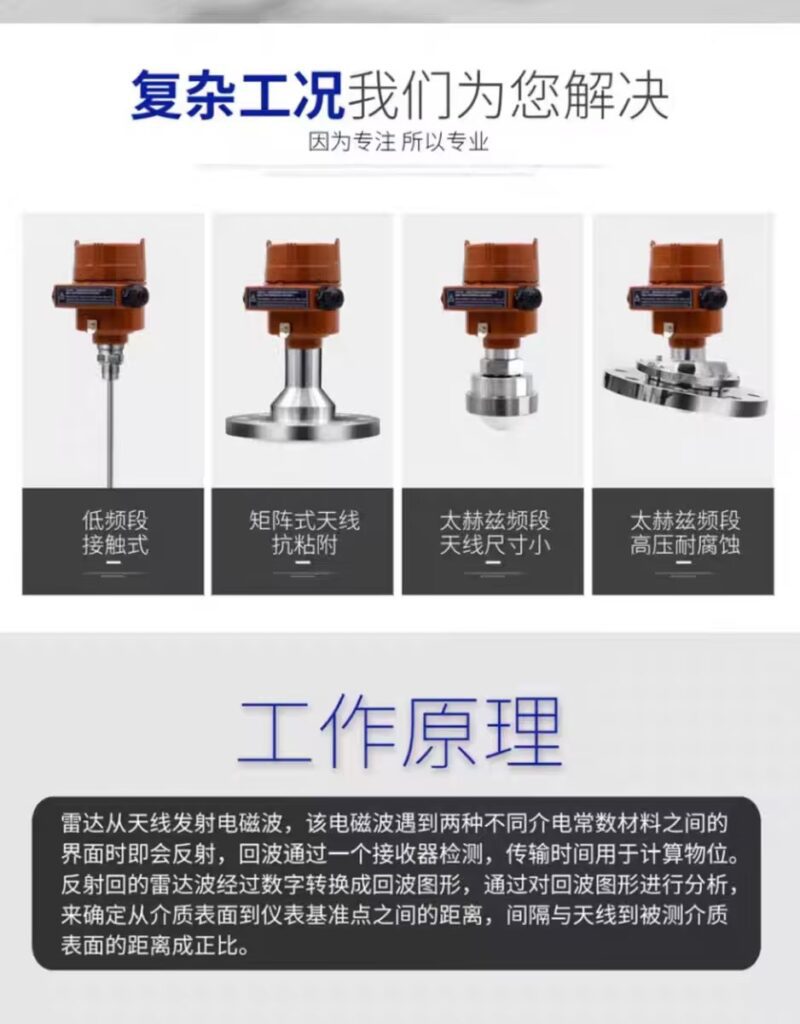
This paper systematically compares the working principles of pulse radar and FMCW radar level meters, analyzes their respective technical characteristics, and summarizes their optimal application scenarios in industrial environments. It aims to provide targeted technical references for enterprises to select appropriate radar level meters according to production conditions, so as to improve the accuracy and stability of industrial level measurement.
1. Introduction
With the continuous upgrading of industrial automation, traditional level measurement methods can no longer adapt to complex working conditions such as high temperature, high pressure, dust and volatile steam. Radar level meters have become the preferred non-contact measurement equipment due to their strong environmental adaptability and high reliability. Pulse radar and FMCW radar are the two core technical branches of radar level measurement. Many industrial users often confuse their performance advantages and application ranges due to insufficient understanding of their working principles. Therefore, an in-depth comparison of the two technologies is essential for scientific equipment selection and efficient industrial measurement.
2. Working Principle Comparison
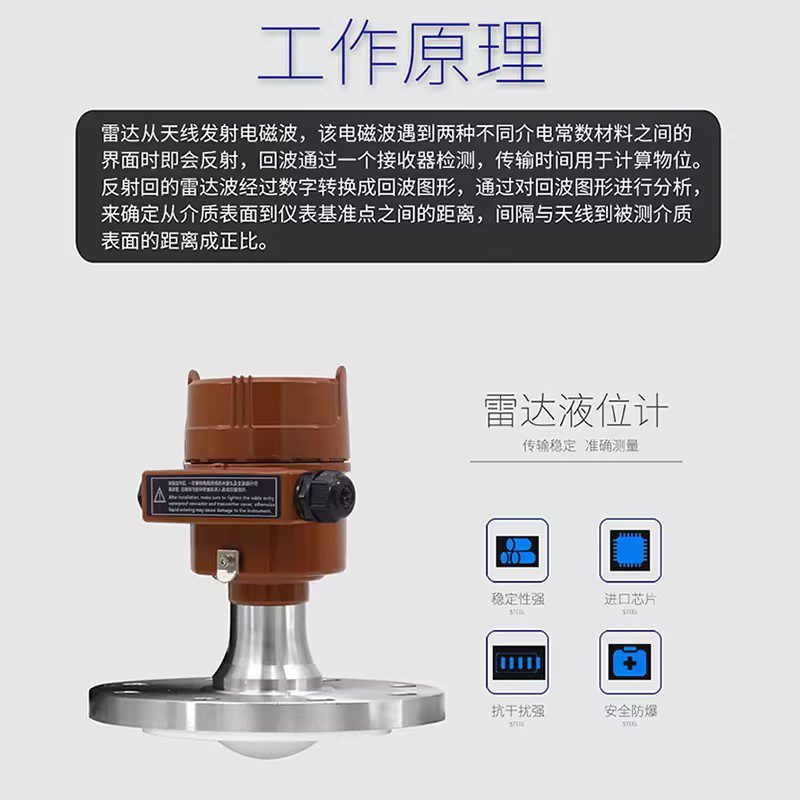
Both pulse radar and FMCW radar follow the electromagnetic wave time-of-flight theory, but their signal emission and calculation logic are essentially different. Pulse radar level meters work by transmitting discrete high-frequency microwave pulses. The antenna sends out intermittent pulse signals, which are reflected after touching the medium surface. The built-in chip accurately records the time difference between signal emission and echo reception, and calculates the distance between the instrument and the medium through the classical time-of-flight formula. Its core measurement logic is based on time difference calculation, with simple signal processing and low algorithm complexity.
Different from pulse radar, FMCW radar level meters transmit continuous microwave signals with linearly varying frequencies. In the working process, the radar continuously outputs frequency-modulated waves. After the signals are reflected by the medium surface and return, a stable frequency difference is formed between the real-time transmitted signal and the received echo signal. This frequency difference has a linear positive correlation with the signal propagation distance. The system converts frequency difference data into accurate level values through high-precision algorithms, without relying on microsecond-level time difference measurement, which effectively avoids the time measurement error of pulse radar.
3. Technical Characteristic Differences
In terms of technical performance, pulse radar has a simpler overall structure, lower hardware cost and lower power consumption. It has stable basic measurement performance and low requirements for on-site environmental conditions. However, its measurement accuracy is limited by the precision of time difference acquisition, and it is vulnerable to interference from weak echoes and turbulent liquid surfaces, resulting in slight data fluctuation.
FMCW radar adopts continuous frequency modulation technology, which has higher measurement resolution and accuracy. It can effectively filter interference signals such as tank wall reflection, foam and dust echoes. Even in complex environments with violent liquid level fluctuation, high pressure and high temperature, it can maintain stable and accurate measurement data. The only disadvantage is that its hardware structure and algorithm system are more complex, leading to higher equipment cost and power consumption.
4. Applicable Scenario Classification
Pulse radar level meters are suitable for conventional and low-precision industrial measurement scenarios. They are widely used in atmospheric storage tanks, water treatment tanks, ordinary chemical medium storage and grain silo measurement. For working conditions with stable liquid level, few on-site interference factors and low precision requirements, pulse radar can fully meet production demands and achieve better cost performance.
FMCW radar level meters are mainly applied in high-precision and harsh working condition scenarios. They are the best choice for petrochemical high-pressure reaction kettles, volatile easy-foam media, turbulent liquid level environments and high-precision material inventory monitoring. In addition, FMCW radar is also suitable for small-range and high-accuracy level detection scenarios where pulse radar cannot meet the precision standard.
5. Conclusion
In conclusion, pulse radar and FMCW radar level meters have their own unique technical advantages and applicable ranges. Pulse radar features simple principle, low cost and stable performance, adapting to conventional industrial measurement scenarios. FMCW radar relies on advanced frequency modulation algorithm, with higher accuracy and stronger anti-interference ability, suitable for harsh and high-precision working conditions. In practical industrial applications, enterprises should comprehensively consider factors such as on-site environment, measurement accuracy requirements and cost budget to select matching radar level measurement equipment, so as to maximize the efficiency and reliability of level monitoring work.
Scan the QR code to receive more detailed information.